
ALPINESTARS ANDES PRO DRYSTAR® XF
Adventure riding gear faces a difficult contradiction. It needs to protect against impact, abrasion, rain, wind, and cold, yet remain comfortable enough to wear for eight hours on the bike. It has to work sitting down on a long stretch of pavement, standing on the pegs through rough terrain, walking around at the end of the day, and adapting when the weather changes faster than the route beneath the tires.
The Alpinestars Andes Pro Drystar® XF Jacket and Pants were designed around exactly that challenge.
Rather than treating the two pieces independently, Alpinestars developed them as a complete adventure-touring system built around its three-layer stretch-laminated Drystar® XF construction. Both garments carry CE Class AA certification and combine waterproofing, breathability, thermal insulation, direct ventilation, and extensive stretch into equipment intended for long-distance riding in changing conditions. The jacket adds Nucleon Flex Pro CE Level 2 shoulder and elbow protection. It is Tech-Air® Ready, while the pants incorporate Level 2 knee protection, Level 1 hip protection, and reinforced inner-leg contact areas.
Those specifications sound promising on paper. But adventure equipment becomes interesting only once the weather stops cooperating.
THREE WEEKS, 3,000 KILOMETERS
We tested the Andes Pro Drystar® XF combination for roughly 3,000 kilometers over three weeks, dividing the riding almost evenly between pavement and off-road terrain. Temperatures ranged from approximately 5°C to 25°C, and the trip brought just about every type of weather we could reasonably have asked for: sunshine, cold, wind, rain, and even hail.
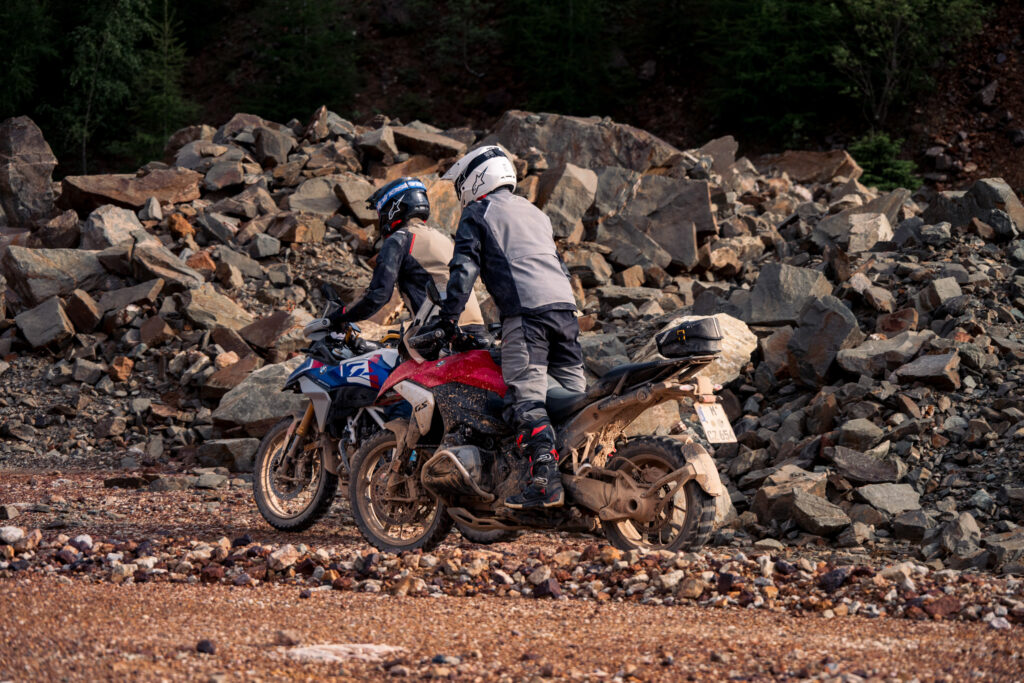
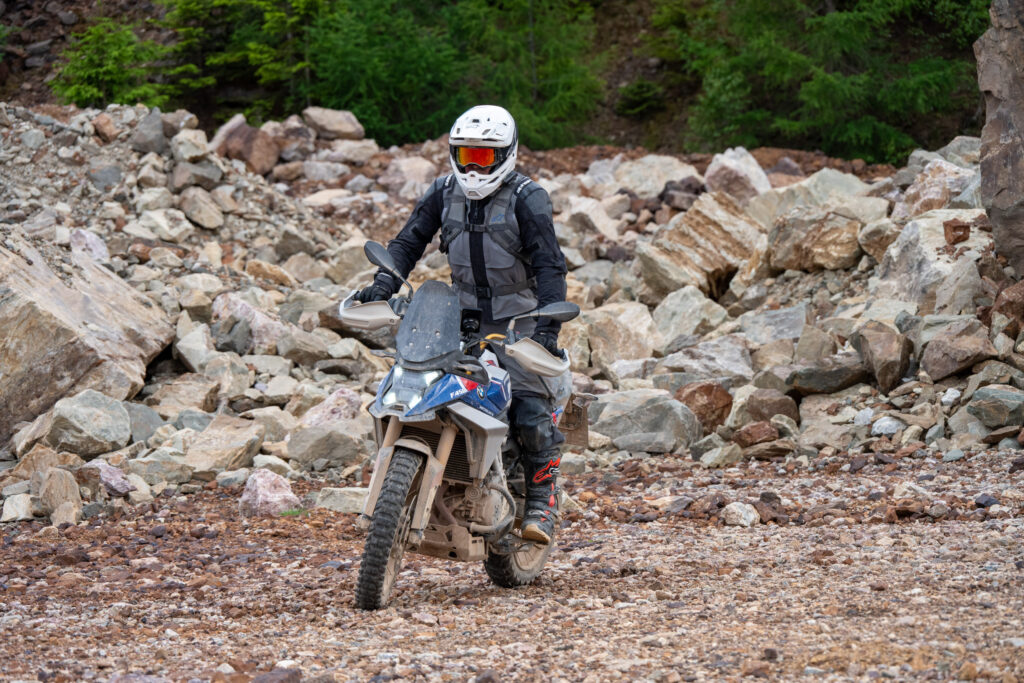
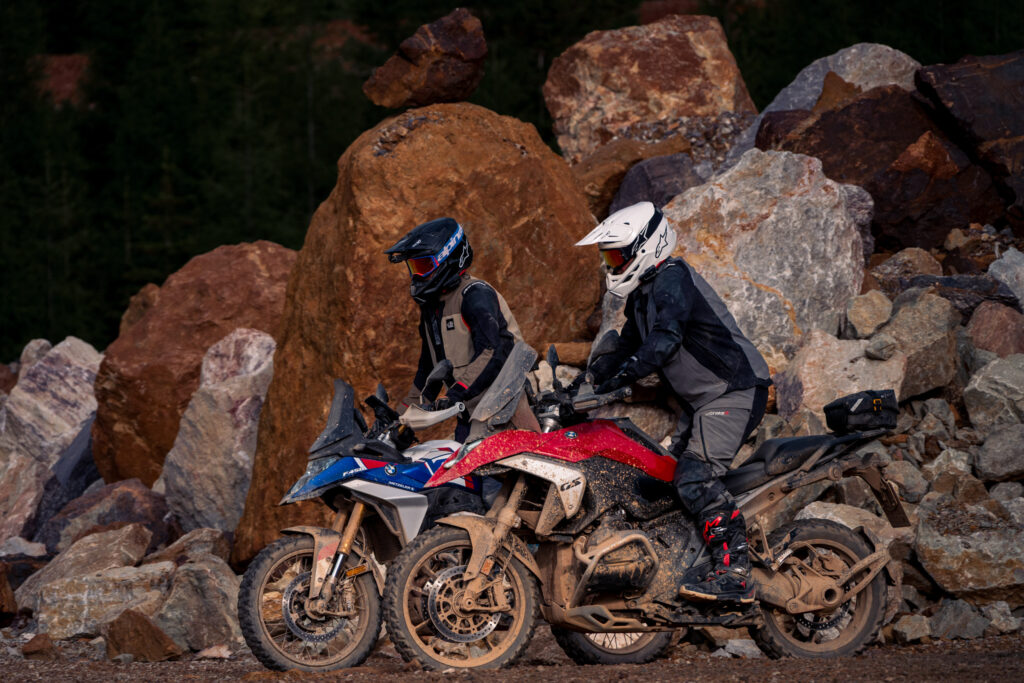
The gear was used aboard a Kawasaki KLE 500 S and a BMW GS 450R, with approximately 70 percent of the riding done seated and the remaining 30 percent standing on the pegs. More importantly, many days involved seven to eight hours of continuous riding.
That matters because comfort after twenty minutes tells you very little about an adventure suit. Comfort after eight hours tells you considerably more.
And comfort became the defining characteristic of the Andes Pro Drystar® XF.
STRETCH THAT ACTUALLY MATTERS
One of the central elements of the Andes Pro system is its three-layer stretch construction. Waterproof laminated motorcycle apparel can sometimes feel stiff, particularly when substantial protection and thermal layers are added. Here, the stretch chassis changes the garment’s character.
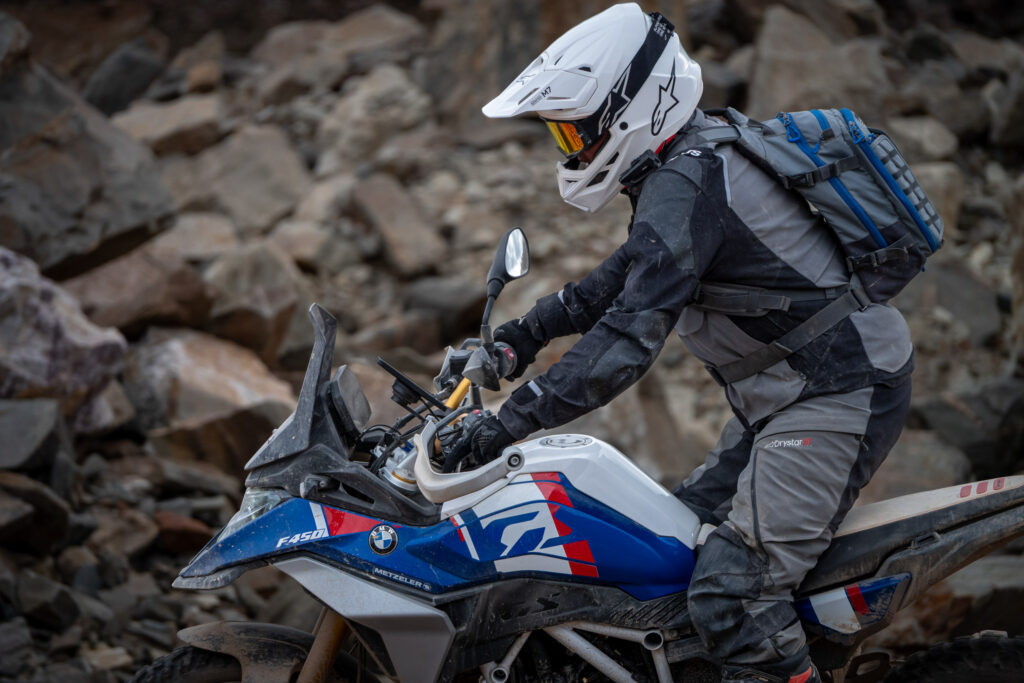
The pants felt roomy without becoming loose, stayed securely in place at the waist, and rose high enough at the back to maintain coverage in the riding position. More importantly, the material never created a noticeable restriction when moving around the motorcycle.
That flexibility became especially apparent off-road. Standing on the pegs, shifting body weight and gripping the motorcycle with the legs all require considerably more movement than highway riding. Even after seven- and eight-hour days, we experienced no pressure points, pulling, or areas that noticeably restricted movement.
The same philosophy carries through the jacket. Its pre-curved sleeves, articulated construction, and stretch-laminated shell are designed around a riding position rather than simply adapting a conventional waterproof jacket for motorcycle use. Alpinestars also uses 120-gram thermal insulation through the body and 80 grams in the sleeves, while the pants use zoned 120-gram insulation from the seat through the upper knee area and 80 grams farther down the leg.
In the temperatures encountered during our test, the system remained comfortable throughout the range.
WHEN THE WEATHER TURNED
The most convincing part of the test arrived when conditions deteriorated dramatically.
During the trip, we rode through an exceptionally severe Oregon storm that brought strong winds, torrential rain, and hail. The worst of it lasted approximately an hour. This was no light shower designed to confirm that water beads off the surface; it was the kind of weather that quickly exposes weaknesses in adventure equipment.
The Andes Pro Drystar® XF system is based around Alpinestars’ laminated Drystar® XF membrane, rated at 15,000 mm waterproofing and 15,000 g/m²/24hr breathability. Unlike equipment that relies on a separate waterproof liner underneath an outer shell, the membrane is incorporated into the laminated construction.
In practice, once the ventilation openings were closed, we experienced no water penetration through the pants during the storm. Equally noteworthy was what happened afterward: the outer material absorbed very little water and, after roughly ten minutes of riding, felt completely dry again.
That distinction matters on a multi-day trip. Staying dry inside is only part of the equation. Riding for hours in a heavy, water-saturated outer garment can become tiring even if the membrane technically remains waterproof.
Here, the laminated construction proved its value.
BREATHING THE OTHER WAY
Waterproofing tends to receive most of the attention in adventure equipment, but excessive heat can make supposedly all-season gear equally unpleasant.
The Andes Pro system uses direct ventilation to address the other half of the climate-control equation. On the pants, two large thigh vents proved particularly effective. They are positioned where the incoming air can be clearly felt and were easy enough to operate while riding, even with gloves.
Fully open, they move a substantial amount of air.
During warmer riding and more physically active off-road sections, the difference between open and closed vents was immediately noticeable. At the same time, during our test, we did not experience problematic internal moisture buildup or condensation.
The jacket follows the same strategy with multiple direct ventilation ports and a high-flow front panel, allowing the two garments to function together as a climate-management system rather than simply as waterproof outerwear.
Within the 5°C-to-25°C conditions of our trip, the combination handled temperature changes particularly well. We did not test genuinely extreme heat or deep winter temperatures, so extending that conclusion beyond the conditions we encountered would be speculation. But within that considerable real-world range, the system worked.
PROTECTION WITHOUT TURNING INTO ARMOR
The complete Andes Pro Drystar® XF system is CE-certified to Class AA.
The jacket uses Nucleon Flex Pro CE Level 2 protection at the shoulders and elbows and is prepared for integration with Alpinestars’ Tech-Air® electronic airbag systems. The pants come standard with Nucleon Flex Pro CE Level 2 knee protectors and Bioflex Level 1 hip protectors.
Our particular setup requires an important qualification.
We removed the standard knee armor because we were riding with separate Alpinestars Bionic Pro Plasma Knee Protectors underneath. The pants had sufficient room to accommodate them comfortably, even over riding base layers, which says something useful about their versatility for riders who prefer independent knee protection.
The supplied hip protection stayed in place and was essentially unobtrusive while riding.
Because we did not ride extensively with the standard knee armor installed, we cannot fairly evaluate its long-distance comfort or positioning. We did find that removing and reinstalling the knee protectors takes some time, which was one of the few inconveniences identified during the test.
DETAILS THAT BEGIN TO MATTER AFTER 3,000 KILOMETERS
Adventure gear often succeeds or fails through details that seem insignificant in a showroom.
The goat-leather reinforcement on the inside of the pants is one example. Alpinestars uses it primarily to improve abrasion resistance in a high-contact area. Still, on the motorcycle it provided another benefit: when standing and gripping the bike with the knees and inner legs, contact against the tank felt precise and secure.
After the approximately 3,000-kilometer test, we found no visible deterioration in the high-contact areas.
The magnetic waist buckle also proved to be more than a design novelty. It is quick and intuitive to operate, particularly when dealing with riding gear and gloves.
The waterproof pockets worked well, although accessing them with gloves was easier while standing than while seated. Interestingly, their position and the way the pants tighten when seated also helped keep objects secure. We unintentionally rode several times with a pocket left open without losing its contents. It’s not the intended security system, but it was a welcome discovery.
Boot compatibility was equally good. We used the pants with 2026 Alpinestars Tech 7 Enduro Drystar® boots and were able to wear the lower leg both outside and inside the boot. An additional calf adjustment helps tighten the pants around the boot when required.
The jacket and pants can also be joined through an integrated connection zipper. However, we did not use that function during this particular test, so we cannot comment on how it affects comfort or mobility when connected.
WHAT THE ANDES PRO DRYSTAR® XF DOES BEST
After three weeks of riding, the most impressive characteristic of the Andes Pro Drystar® XF was not a membrane specification, an armor certification, or one clever fastening system.
It was how little we had to think about it.
Good adventure equipment should eventually disappear from the rider’s attention. It should let you stand, sit, move, get cold, get warm, encounter rain, leave the pavement, and spend another few hours riding without constantly adjusting or fighting what you are wearing.
That was where this Alpinestars combination excelled.
We tested its waterproof performance in genuinely difficult conditions. Its ventilation made an immediate difference when temperatures increased. Its stretch construction remained comfortable through seven- and eight-hour riding days. Its fit also accommodated both conventional adventure use and our preference for independent enduro knee protection.
This doesn’t make it ideal equipment for every discipline. For dedicated hard enduro or motocross, we would choose lighter and more specialized gear. But that is not what the Andes Pro Drystar® XF was designed to be.
For adventure travel and long-distance touring, especially when the route includes both pavement and dirt and the weather forecast cannot be trusted, it makes a compelling case.
Asked at the end of the trip to identify its strongest quality in one word, the answer was simple:
Comfort.
And after 3,000 kilometers of asphalt, dirt, cold, rain, wind, and hail, that may be the most meaningful compliment an adventure riding suit can receive.
Photos/Videos: BTA Media – Words: Thomas Ferrero
Related Articles

Red Bull Romaniacs 2026 Adventure Bikes Find Their Race
Red Bull Romaniacs has spent more than two decades sending riders into the Carpathian Mountains with a GPS, a motorcycle, and very little room for error. The 2026 UNSTOPPABLE edition carried that...
Daniel Sanders Rules the 2026 Desafío Ruta 40 YPF
From San Juan to San Rafael and back again, the Red Bull KTM rider turns a brutal week in western Argentina into a commanding rally-raid victory.The 2026 Desafío Ruta 40 YPF ran from May 24 to 29...
Where the Sun Refuses to Leave
Riding to Nordkapp - Chapter 3 of 3By the time the road turned toward Norway, the journey had already become more than a route across Europe. Behind were long days through England and Scotland, the...