
Midnight Sun, Gravel, and Gravity-Fed Fuel
Three friends, three classic Hondas, and a 6,000-mile odyssey to the pinnacle of Europe and back.
The Mission
Back in August of last year, two friends and I embarked on what would be our most ambitious adventure on two wheels yet. My name is Abel Bendall, and together with Harry Moriarty and George Box, we make up Trailworn — where high-quality filmmaking meets adventure motorcycling. Having previously ridden across France and Spain, we set our sights much further afield: Scandinavia.
Our goal was to reach the pinnacle of Europe — Nordkapp — a dream we had decided on the previous year while on a lap around France on adventure bikes. The plan was simple: ride from Dorset, in the south of England, to Nordkapp and back again in three and a half weeks. To make this possible, we would take the motorways to the south of Sweden, using a few short ferries along the way. Once in Sweden, we planned to ride north solely on the Trans Euro Trail, cross briefly into Finland, and then make our way into Norway. After reaching Nordkapp, we would return home through Norway, rejoin the motorway network in Denmark, and take the most direct route back. Alongside the ride, we planned to document the journey with the aim of creating a short cinematic film.
Sweden and the Right to Roam
On the 2nd of August, we loaded up our bikes — three XRV750s — and made a beeline for the port of Dover. After crossing into France, we began the long motorway slog north towards Sweden. The ride through France, Belgium, and Germany was uneventful, and we plodded on eagerly, keen to reach Sweden — a country none of us had visited before. That night, we slept under a tarp behind a petrol station somewhere in Germany before continuing the next morning to catch the ferry from Puttgarden to Rødby in Denmark. From there, we made a final push over the Øresund Bridge and finally arrived in Sweden.
It felt surreal to be there so soon. As we left Malmö and escaped the city, we began to familiarise ourselves with the Swedish landscape. Traditional red farm buildings were scattered across vast expanses of farmland, broken up by dense pine forests. As evening fell and the forests became more expansive, we began looking for a place to camp, eager to make use of Allemansrätten — Sweden’s right to roam — which made finding wild camps far easier than elsewhere in Europe. We pitched up beside a small lake and settled in for the night.
On day three, checking our navigation software really put the scale of the task into perspective. We were a tiny dot, barely an inch into Sweden, on a map that seemed to stretch endlessly across our phone screens. This would be our first full day on the Trans Euro Trail, and a good indicator of how much ground we could realistically cover in a day.
Rhythm of the Trail
With the bikes packed, we hit the trails at 7am sharp. The weather was mild, with occasional showers that made little difference as we got to grips with the endless loose gravel roads. We were settling into the rhythm of the trip and made good progress, stopping only briefly. The trails were great fun — relatively easy, but very different from anything we were used to riding in the UK. At one point, George got a bit over-excited and overshot a corner, landing harmlessly in a soft patch of bushes. He dusted himself off, and we carried on. We rode all day, stopping once for fuel and a hotdog.
As evening approached, I pulled up the Shelter app on my phone — a database of primitive huts and shelters scattered across Sweden that are free to use. Finding one would mean dry gear and protection from the unpredictable weather. We selected a shelter on the map and headed for it as the light began to fade. The track led us along a narrow trail beside a cluster of lakes, eventually arriving at an incredible spot. A lakeside shelter with a jetty stretching out into the water and uninterrupted views across the lake. We couldn’t believe this was somewhere we could stay free of charge. It completely changed the trip. We slept packed in like sardines, tents staying dry and unused, and were able to pack up in half the time the next morning. We were really starting to like Sweden.
The following days followed a familiar rhythm but were somehow all unique. We woke at 6am, rode from 7am, and spent the days cruising gravel roads. Around 7pm, we’d consult the map and hunt for a shelter. Each one differed in location and comfort — from enclosed A-frame huts that felt luxurious, to basic lean-tos with a fire pit. Evenings were spent swimming in crystal-clear lakes, warming up around a fire, and reliving the day’s riding. We saw almost no one. It felt like we had the entire country to ourselves — the purest sense of isolation I’ve ever experienced, something I still dream about when caught up in everyday life.
Into the Arctic
By the 8th of August, we were making incredible progress and were closing in on the Arctic Circle. By midday, we were parked beneath the sign marking the boundary — a huge milestone just six days after leaving the UK. Inside the Arctic Circle, the nights never truly got dark, with a constant glow lingering on the horizon. We camped by a lake that night, just miles from the Swedish–Finnish border.
We woke early on the 9th, ready for a big day. By 9am we had crossed into Finland, and by 11am we were in Norway. We expected more tarmac here, which meant faster progress toward Nordkapp. Around midday, the Trans Euro Trail diverted us onto an incredible off-road section — some of the most technical riding we’d done so far. It was the perfect chance to let off steam and capture footage across the Arctic tundra. By 2pm, we rolled into Alta, grabbed hotdogs, and decided to push on. We knew we’d be retracing this route later, so we committed to a big push up the Nordkapp peninsula — road miles all the way.
The terrain had changed dramatically. Gone were the endless pine forests, replaced by vast, barren plateaus battered by strong crosswinds. Campervans clogged the roads, all heading for the same destination. With the sun shining and spirits high, we knew we’d reach Nordkapp that evening — just 50 miles (80 kilometers) to go.
Breakdowns and Breakthroughs
Then George came over the comms: his bike was losing power. He rolled to a stop and we pulled in behind him, initially almost excited for our first roadside repair. Months of preparation meant we carried spares for most scenarios, and George knew his bike inside out. A quick inspection revealed three melted wires to the regulator/rectifier. We taped them up, the bike fired back into life, and we continued.
A few miles later, George was stranded again. This time, we turned our attention to the fuel pump — a common weak point on old XRVs. The pump was working intermittently, but luckily George had brought a pre-wired spare. We swapped it out, got the bike running, and carried on. By now it was around 8pm, and we were riding in a strange state of delirium through a truly magical landscape. Crossing the tunnel onto Magerøya — the island home to Nordkapp — felt surreal. Sweeping roads carried us ever closer, and at around 11pm we finally rolled into the Nordkapp visitor centre, utterly exhausted. We decided to sleep and return early the next morning to beat the crowds. The sun barely dipped below the horizon, and the night never truly fell.
The Pinnacle of Europe
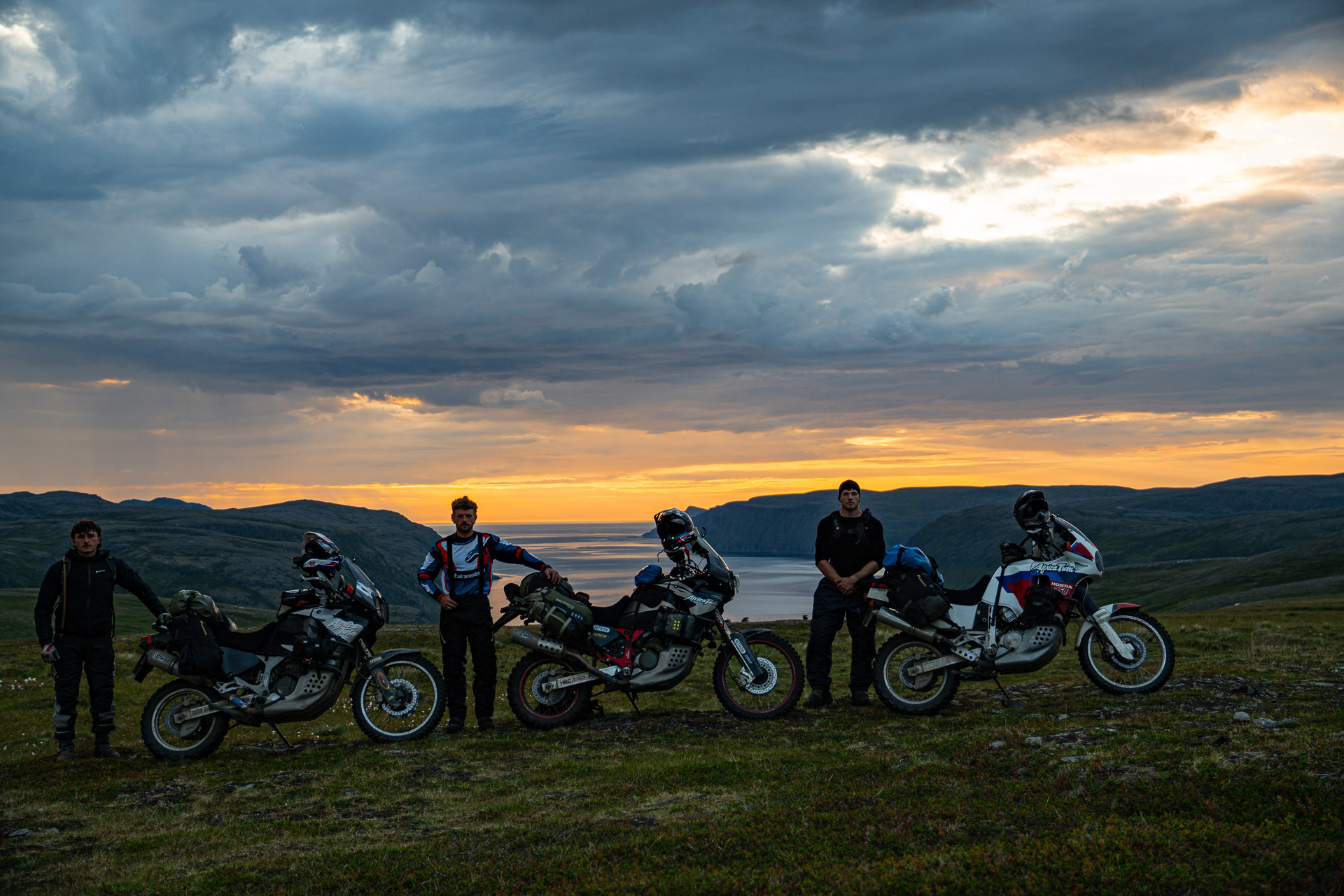
At 3:45am on the 10th of August, our alarms went off. We hadn’t come this far to be surrounded by coachloads of tourists. We wanted quiet reflection — and a photo beside the monument. We rode up to the globe under clear skies, sharing the moment with just one other pair of bikers. Standing on a 300-metre cliff overlooking the Barents Sea felt unreal — a point we’d dreamed of reaching a year earlier. We spent an hour taking it all in before turning south towards Alta.
The ride back felt effortless. Warm, still, and empty roads allowed us to fully appreciate the landscape. George’s bike held together, and we were back in Alta by mid-morning. We’d completed the first stage of our trip in just over a week.
Turning South: Lofoten and Tarmac
After returning to Alta, we turned our attention to the next phase of the trip: Norway. Our plan was to ride south through the country, visit the Lofoten Islands, and then link up with the southern Norway Trans Euro Trail to get back off the tarmac. From there, it would be a gradual journey home. We made a beeline for the Lofoten Islands. Although we were still far north, there was very little off-road riding available in this part of Norway, so we followed the tarmac as it wound its way through dramatic fjords.
Around 2pm on the 10th, we stopped and set up camp beside a river, deliberately ending the day early to recover from the previous push. We spent the afternoon swimming, resting, and resetting ourselves for the next chapter of the journey. With Nordkapp behind us, every mile now brought us closer to home, and we could afford to slow things down and enjoy the ride.
On the 11th, we woke up ready to cover some distance and tick off a few essential tasks. Our rear tyres were beginning to show serious wear, and a quick search online revealed very few motorcycle shops in this remote region. We were due to pass one that day, so we hoped to source some fresh rubber and fit it further down the road. We also needed to restock food supplies before spending a few days exploring Lofoten. In the town of Narvik, we struck gold. A shop called Motonor AS had rear tyres in stock and couldn’t have been more helpful. We loaded the tyres onto our bikes and continued on towards the islands.
Once again, we found ourselves riding late into the evening. The scenery was staggering — sheer cliffs rising straight out of the ocean, with a ribbon of road clinging to the coastline. As we ventured deeper into Lofoten, finding a place to camp became increasingly difficult. The area was busy, with frequent “no camping” signs and far more traffic than we’d encountered anywhere else on the trip. At around 8:30pm, George’s bike began losing power again. Any novelty surrounding roadside repairs had long since worn off, and being this far from a proper workshop was worrying. Thankfully, we managed to file down the electrical contacts on the fuel pump, which were sticking together. The fix worked — for now — although we knew it wouldn’t be the last time we’d be dealing with it. It was close to 11pm by the time we finally found a spot to pitch our tents.
The following day, the 12th, we made a conscious effort to enjoy Lofoten properly rather than chasing miles. We meandered through fishing villages, stopped frequently, and kept an eye out for potential campsites throughout the day. Once again, the weather was on our side. Around 4pm, we found an excellent spot and settled in early, enjoying a relaxed evening soaking up the views. We booked a ferry back to the mainland for the following morning, sailing from Moskenes to Bodø.
Festivals and Flat Tires
Over the next few days, we worked our way south toward the Southern Norway Trans Euro Trail. The weather deteriorated, and we pushed on through cold, wet conditions, eager to get back onto the dirt. As we headed south, temperatures dropped sharply, and when we passed the Arctic Circle visitor centre, it was hovering around 0°C. We made a brief stop in Trondheim to replace our drone, which had failed earlier in the trip.
On the 15th, we finally rejoined the Trans Euro Trail — a huge relief after nearly a week on tarmac. The riding was superb, taking us high up onto exposed plateaus with breathtaking views in every direction. The weather improved dramatically, and for the first time since leaving the UK, it genuinely felt like summer. That evening, we found a peaceful campsite beside a small stream and settled in, content after a brilliant day of off-road riding.
The following day became an unplanned maintenance day. We were still carrying the rear tyres we’d bought in Narvik, and constantly strapping them to our luggage was becoming a pain. Early that morning, we found a petrol station with a decent air compressor to help seat the beads. With all the tools we needed, we got to work. We also decided to flip the front tyres to squeeze out a bit more life.
The job took most of the day, and as we worked, we noticed something unusual happening in the nearby village. Tractors were rumbling past nonstop. A bit of investigation revealed that we’d accidentally landed in the middle of the Traktorrock Festival in Vågåmo. Intrigued, we stashed our bikes and gear behind the petrol station and headed into town to see what it was all about. Travelling light meant we owned little more than riding kit and Crocs, so we must have looked like a proper ragtag trio. The first pub we wandered into served Guinness, and from there, the evening became a blur. We drank, chatted with curious locals, and were eventually dragged onto the dance floor to attempt a traditional dance — the name of which still escapes me — but it certainly wasn’t easy. It was a completely unexpected and unforgettable night, and we stumbled back in the early hours to sleep rough behind the petrol station.
We woke the next morning with sore heads and ringing ears, but thankfully the weather was perfect. After packing up, we hit the road, leaving Vågåmo and Traktorrock behind us. Just a few miles later, I suffered a puncture. I’d overinflated my tyre while setting the bead the previous day, damaging the tube. A quick roadside swap sorted it, and the rest of the day delivered some of the best riding yet. We finished by camping beside a river with a waterfall — the perfect cure for the lingering effects of the night before.
Limping Home
The following day brought more incredible trails through Arctic tundra, unlike anything we’d ever ridden before. By mid-afternoon, George’s fuel pump problems returned — this time for good. We’d exhausted both spare pumps, and it was clear we needed a completely new solution. After an evening of research, we identified a suitable alternative available from a Biltema hardware store just a few miles from our chosen roadside camp. The next morning, Harry rode ahead to buy the pump while George and I stripped his bike down in preparation. By mid-afternoon, the new pump was installed and working flawlessly.
The date was the 19th of August, and we were conscious of the clock — we needed to be home by the 25th to return to work. By the 20th, we had crossed back into Sweden and were making strong progress toward Gothenburg, where we planned to catch the ferry to Denmark before the final push home. That evening, we found an incredible hut via the Shelter app, complete with raised beds and a wood burner. It was our first night not sleeping on the ground since leaving the UK. Ironically, it turned into one of the worst nights of the trip — partly because we got a little too enthusiastic feeding the fire.
On the 21st, we committed to heading home. We boarded an afternoon ferry to Frederikshavn in Denmark and immediately began riding into the night toward Calais. We seem to have a tradition of ending trips with frantic, motorway-heavy final pushes — a last burst of madness to get the miles done. At around 11pm, disaster struck again: George’s fuel pump failed completely. Faced with a choice between stopping and sourcing another pump or bypassing it entirely, we opted for the latter. By gravity-feeding fuel to the carburettors and carrying spare fuel cans, George could limp along — albeit at no more than 60mph (96 km/h). All we wanted was to get home. In hindsight, it wasn’t the safest decision. Crawling along the German autobahns at 50mph (80 km/h) while cars blasted past at double that speed was unnerving. We pushed through the night, grabbed an hour’s power nap, and continued on. Eventually, George’s bike mysteriously picked up pace again, easing the final stretch. We rolled into Calais around 6pm and caught Le Shuttle back to England, finally arriving home around 11pm. A brutal, unforgettable end to an unforgettable journey.
Epilogue
Once home and properly rested, we were able to reflect on what we’d achieved. The trip totalled over 6,000 miles (9,656 kilometers) through some of the most breathtaking landscapes we’ve ever seen — shared with my two best friends, countless laughs, challenges, and moments of pure awe. We captured footage we’re incredibly proud of, and since releasing our 10-minute film on YouTube, the response has been overwhelmingly positive. We’ve spoken to many people now planning similar journeys, and if there’s one thing we hope to do, it’s inspire others to believe these adventures are possible. It all started with an idea — and the belief that we could make it happen.
Words by: Abel Bendall – Photo Credits: Abel Bendall
Articles in this issue
Abu Dhabi Desert Challenge 2025
Five Days of Sand, Sweat and SurvivalThere’s a certain silence in the desert that speaks louder than engines. It’s the kind of silence that wraps around your helmet as you stare into a horizon that...
Patagonia Between Trails and Friends
A Pact Between Friends and Mountains“You have to come to Patagonia.” After all, I’d already taken Simon Cudby and Randy Commans, also known as Offroadunderground, through the dusty trails of...
A Loop Through Spain’s Desert Trails
Where the Silence Smells Like DustIt was still dark when I unzipped the tent and stepped into the chill. My boots sank slightly into the dry earth, the kind that holds yesterday’s stories in the...
The Journey Across the Americas
From Ushuaia to Alaska Chapter 7 - Mexico City to LADiego Rosón’s Epic Adventure on a Royal Enfield Classic 500After thousands of miles already behind him, Diego’s journey was far from over. In this...
2026 BMW R 12 G/S
2026 BMW R 12 G/S Built for Dirt, Born from Legacy.There are motorcycles that spark curiosity, and then there are those that stir something deeper, something primal. The kind of feeling that starts...
Aprilia Tuareg Rally
Aprilia Tuareg Rally The Twin-Cylinder Weapon for Real Off-Road RidersWhat happens when a serious off-road machine meets the mindset of a true adventure rider? You get the Aprilia Tuareg Rally, a...