
Let the Desert In
A Father, a Son, and the Paris-Dakar Dream
Some trips start with a plan. Others start with a question. In this one, Egidijus points his front wheel toward Morocco knowing the terrain, the heat, and the demands of the route. What he doesn’t fully know is how the days will unfold, what moments will stay with him, or how much of the journey will happen once the engine is off. This is a ride shaped by long distances, simple logistics, and a deep respect for the desert. No shortcuts. No noise. Just movement, decisions, and time.
Three days on the trail. One bike. A desert that asks for attention and gives nothing away for free. What you’ll read here comes from the rider’s own notes, stripped down, honest, and focused. There’s solitude, yes, but also small connections, quiet reflections, and the kind of moments that don’t need much explaining. These are the stories that stay with us. And the road that ends with someone waiting is never really the end.
Three days across dunes, dust, and stone — chasing rally dreams, and finding something more.
Where the Silence Begins
Morocco is a paradise for rally lovers.
Every year, it hosts around twenty professional events, with an amazing variety of tracks and routes to explore. And out of all of them, my favorite is still the legendary Paris-Dakar.
It’s been capturing my imagination for years, and I’ve been lucky enough to ride a few of its trails. But the Moroccan stretch from Boudenib to Tata is by far the most spectacular and exciting I’ve seen. I set out solo to explore the area and the route itself.
I know this kind of terrain well, so planning was easy. I used Wikiock to map it, checked satellite images, and read a few reviews from other riders. Of course, in the desert, routes can always shift a little. But that’s part of the charm.
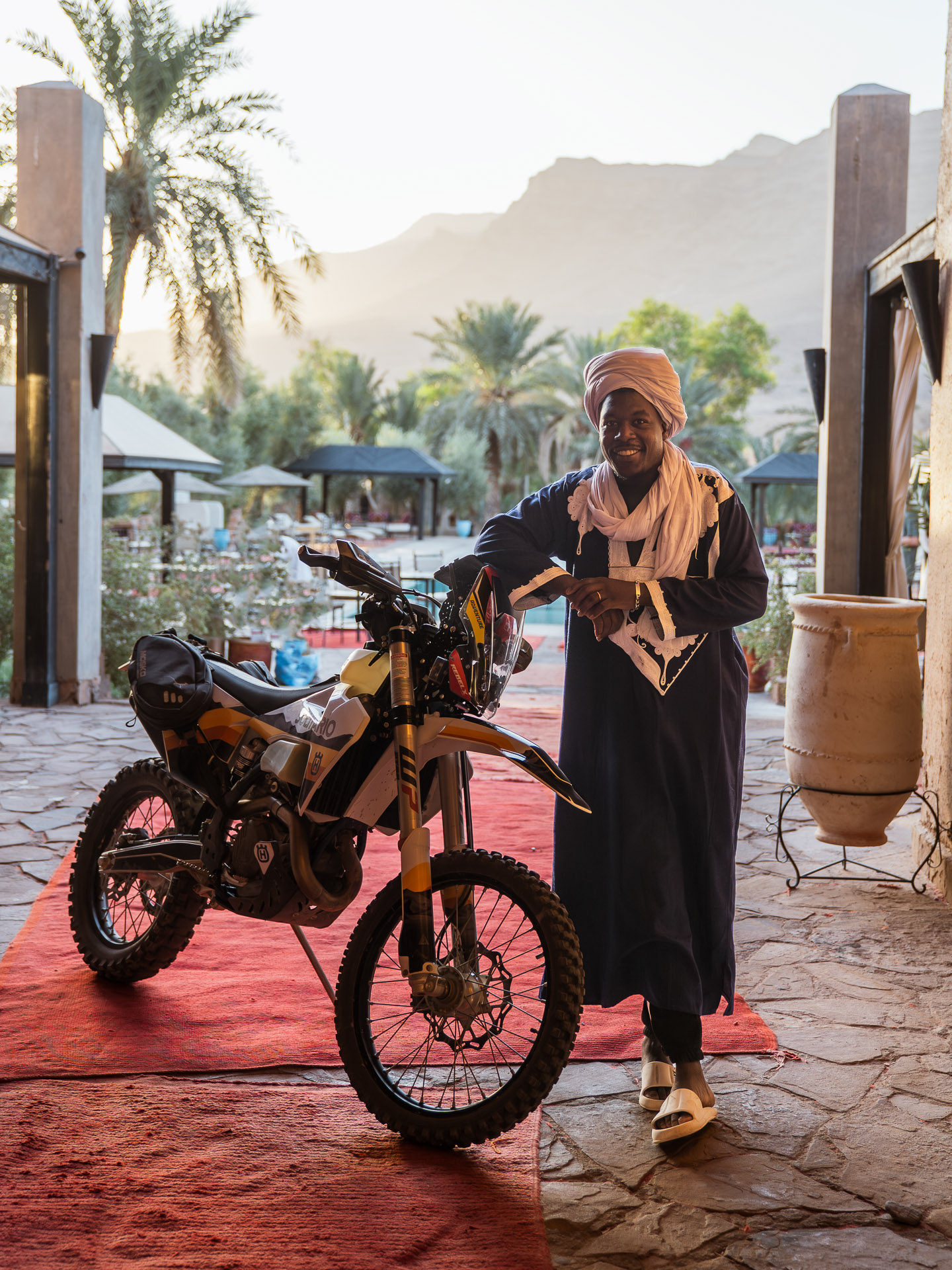
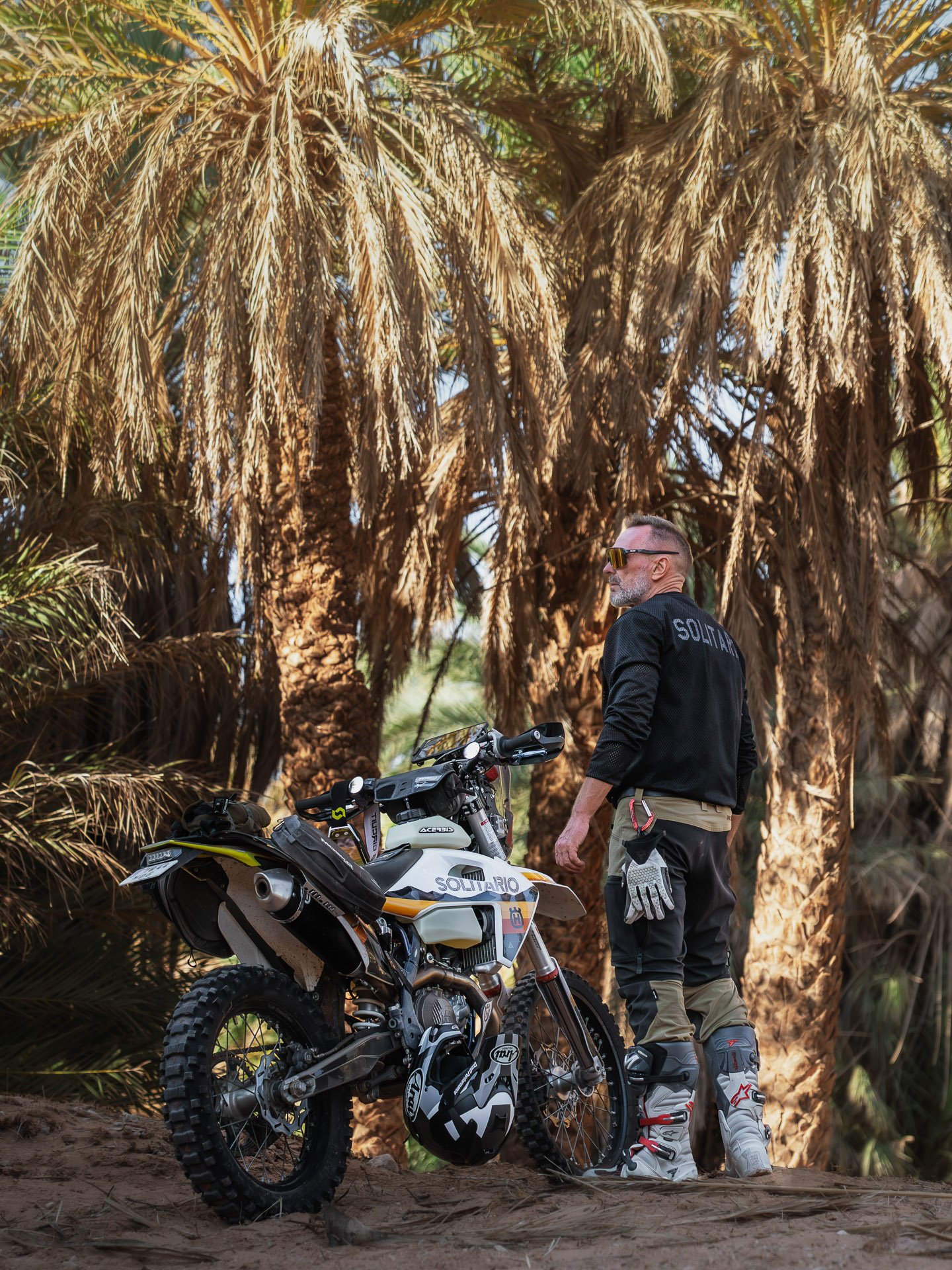
I brought my Husqvarna FE450 with a bigger fuel tank, GPS, and mousse inserts, no tubes, because they just don’t hold up on that kind of ground. For navigation, I used a Samsung Active5 with DMD2 software.
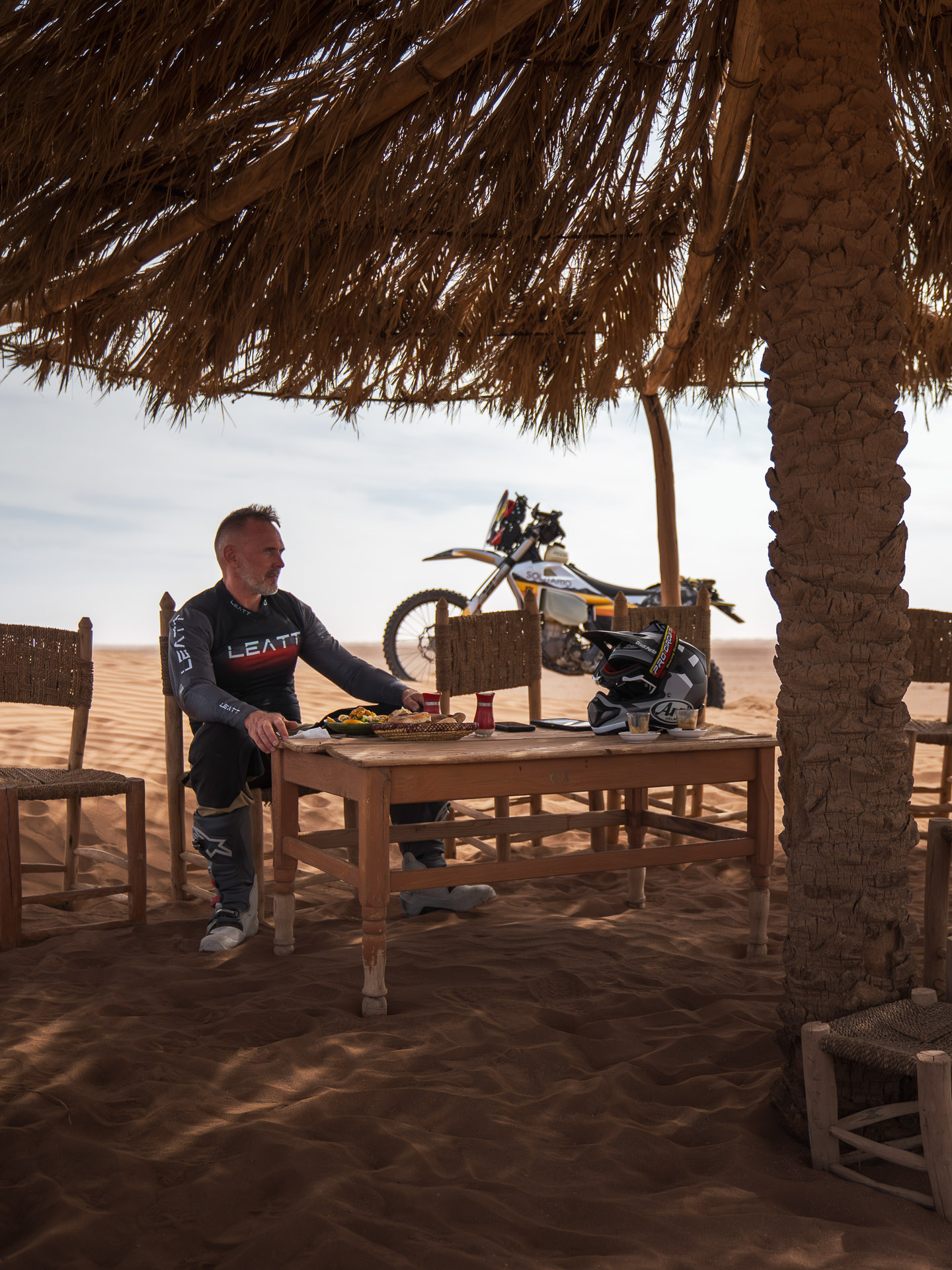
For this ride, I kept it simple as always. Arai MX-V EV helmet, Alpinestars Tech7 boots, Mosko Moto gear, Leatt protection.
On the bike, I had my Sony C7 II camera with a 24–70mm f/2.8 lens. Great balance of quality and weight. I carried only the basics: water, a bit of food, the camera, and a tripod.
My son was waiting for me at the end of each day with the camper van. That was our meeting point. I slept there every night.
On the first night, we stayed at the Bivouac de François Rekkam in Boudenib, a well-known place for adventure riders. We had dinner at the restaurant there, which was full of travelers. Some, like us, were just beginning their journey, full of energy and enthusiasm, while others were wrapping theirs up, tired, but filled with memories. There are plenty of places to stay along the way, it’s a popular route among adventure riders. But nothing beats ending a long ride with your kid, a warm meal, and a cold beer.
I left Boudenib early in the morning. The air was dry. No wind. Everything was in place.
Somewhere down the track, I stopped.
I wondered if the desert would let me in.
Boudenib → Merzouga: Warmed by the Sand, Cooled by the Silence
The first day was about 125 miles (200 kilometers). A solid warm-up.
I left early, after a proper breakfast, essential before a long ride under the desert sun. The morning was cool, dry, and silent. By noon, the heat was already pushing through the layers. Picking the right gear for this terrain is key. The FE450 demands full focus. One wrong move out here, and things can go south real fast. I was glad I had the Arai MX-V on, solid, well-ventilated, and exactly the kind of helmet you want when riding solo through this kind of heat.
The first 60 miles (100 km) went by fast. Open trails, good traction, no surprises. After passing the Safsaf oasis, I dropped into a mix of sand and stone, a dried riverbed with soft patches.
Then came the only fall of the whole trip. The front tire slammed into a hidden rock, and I had to let the bike drop. Nothing broke. Just a reminder: even when you know the terrain, the desert always throws something at you.
By late afternoon, I rolled into Merzouga. The dunes were glowing. I couldn’t resist, I did a short ride across them and stopped to watch the sun go down.
The light was soft, the sand warm. No sounds. Just that moment.
My son was already there with the van. He handed me a plate of food and a cold beer.
After eating, he asked to try my bike on the dunes. It was his first time riding off-road. He went out for about half an hour, and when he came back, he just said, “Riding in the dunes is exhausting.” I smiled. That was enough.
We didn’t say much. We didn’t need to.
I slept well that night.
Merzouga → Mhamid: Dust, Distance, and a Quiet Understanding
Day two was a long one, around 220 miles (350 kilometers). I left Merzouga at sunrise, with the dunes behind me and a full tank ahead.
The first few miles were calm. Then came the dunes. About 6 miles (10 km) of soft sand that kept me fully alert. After that, sandy trails led toward Ramlia. The GPS line looked clean, but the terrain was anything but.
I crossed a dry riverbed and picked up some speed. The trail opened up, fast and loose. But it stayed risky, big holes, dry channels, patches of soft gravel. In Ramlia, I stopped for gas. Plastic jugs, sold off the back of a truck. It’s normal here, and essential.
By the time I reached Tagounite, I was feeling the heat and the distance. A cup of Moroccan tea and a handful of cookies gave me just enough to keep going. There were still about 50 miles (80 kilometers) left for the day.
The trail started getting trickier, more rocks, loose sand, and hidden bumps. I kept the pace steady.
Just before Mhamid, the desert began to feel less like scenery and more like something you have to read. You listen to the tires. You feel the weight of the bike. You measure each move.
I reached Mhamid in the late afternoon. Found a good spot at Kasbah Sahara Services, they had space for the camper. Perfect.
My son was already there. We jumped in the pool. Not luxury, just what the body needed.
That night, we were both too tired to cook anything special. We ate whatever we had in the camper and opened a couple of beers. I told him about the day. He listened closely. He looked like someone who had just discovered a different kind of riding.
Dinner was simple, and the evening was quiet. The kind of silence you only get after a tough day in the desert.
I went to sleep with the bike running fine, the tank full, and my head already thinking about the dunes of Chegaga.
Mhamid → Chegaga → Lake Iriki → Tata: Dunes, Nomads, and the Need for Speed
Day three started early again. I left Mhamid with around 185 miles (300 kilometers) ahead of me. The plan was to cross the dunes of Chegaga and reach Tata before nightfall.
The first stretch followed a dry riverbed, about 25 miles (40 kilometers) of loose rocks and shallow sand. It was quiet, and it felt like the desert was waiting to see what I’d do.
Then the dunes began to rise. Small ones at first, then bigger, sharper shapes. I was in Chegaga.
For me, this is the most beautiful part of Morocco. There was no real trail, just the wind, the sand, and the freedom to ride. I took a break from the route and let the bike loose across the dunes. No destination, no pressure. Just riding for the joy of it, like a kid playing in a giant sandbox.
At one point, while riding across the dunes, I felt something shift. Not in the bike, but in me. For a second, it felt like I was inside the Paris-Dakar rally. I could picture the riders, the struggle, the noise, the solitude.
Somewhere near the edge of the dunes, I met a local man. A nomad. He only spoke Berber, and I didn’t know a word of it. But we managed to communicate through simple gestures and sketches in the sand.
He asked for some dirhams. I gave him 20, and he smiled and let me take a photo. He told me he had a wife, but she was out with the goats. Or at least, that’s what I understood. There weren’t many other places to go.
After the dunes, the trail opened into the dry bed of Lake Iriki. The surface was flat and endless, the kind of place where you twist the throttle just to see how far you can push it.
I went fast. Really fast. It felt like taking off.
I stopped once to look around. The silence was massive. No birds, no wind, no echo. Just dust and sunlight.
There are a few guesthouses near Iriki, and you can find gas and food there if needed.
The last stretch toward Tata ran along a rocky mountain slope, with occasional holes filled with rainwater. I slowed down. After all that speed and sand, it felt right to end steady.
I reached Tata in the evening. Tired, hungry, but satisfied.
My son was waiting again. We had dinner with whatever we had left. Neither of us is much of a cook, but the beer was cold, and that helped.
We talked about the trip. He asked questions. Listened more than he spoke.
I think something changed in him during this ride. He might switch from road to dirt someday.
I hope so.
What the Desert Gave Me
Each day was a challenge, but the toughest one was the stretch between Mhamid and Lake Iriki. It pushed both me and the bike to the limit. The Husqvarna made it through without a single issue, still running as strong at the end as it did at the start.
Along the way, I met all kinds of people. October is peak season in Morocco. Around Mhamid, the tracks fill with experienced riders and desert lovers from all over. Some were at the end of their trips, others just beginning. Everyone had a story. I remember watching camels crossing Lake Iriki, and even taking a photo with them. A local man offered me dates and nuts. Simple gestures. Unforgettable moments.
The local food deserves a chapter of its own. I’m a big fan of tajines, and I ate well throughout the trip. But there’s one place that stood out: Chez Marrakech in Merzouga. If you’re after real flavor and culture, that’s the place.
Language is never a barrier here. French helps, but out in the desert, gestures go a long way. A sketch in the sand says more than enough.
The FE450 demands focus. It reacts to everything. You have to read the ground and stay with it. That kind of riding wears you down, but it’s what I came for. A way to push myself and keep the edge. This ride felt like training for something that hasn’t happened yet.
This trip had its own rhythm. The FE450, all power and precision, kept me alert at every mile. Out there, every decision mattered. I had to stay sharp, knowing when to push and when to hold back. Each mile gave me something to take forward. This ride became a way to measure myself, to train for what’s coming next.
The desert doesn’t forgive distractions. Every dune hides something. Even when the track looks smooth, there might be a deep hole waiting. My advice: keep it light. Enjoy the sand. If your bike weighs 440-pound (200 kilos), maybe ask yourself if you’re the one riding it or just hanging on. I’ll definitely ride this route again. Living in Spain, the Sahara is almost at my doorstep.
I’ve been to Morocco fourteen or fifteen times. Taken hundreds of photos. Some were lost along the way, but a few stayed with me. My favorite is of a man named Chegaga, a nomad I met deep in the desert. He was sitting on a hill, his small home and a handful of goats behind him. There was nothing flashy about the moment. But as I watched him, I thought, he seems to have so little, and yet somehow, everything.
That quiet. That open horizon. The soft push of the Saharan wind. I still think about it.
But if I had to choose one image that holds the whole trip, it’s the one of me standing at sunrise in the dunes of Merzouga. The light low, the sand still cold, and the road ahead wide open. I remember thinking: will the desert let me in?
When you ride into the desert, you never really know what it will give you. Or what it will take.
Every person you meet is a new story. Every mile teaches something. Every curve changes you, a little.
This trip was different from all the others. It didn’t end when I got home. It ended when my son was there, waiting for me, camper parked, ready to listen.
And maybe that’s what changes everything.
The road used to end at the finish line.
Now, it feels more like the start of something else.
Words by: Egidijus Pudziuvelis – Photo Credits: Egidijus Pudziuvelis
Articles in this issue
Abu Dhabi Desert Challenge 2025
Five Days of Sand, Sweat and SurvivalThere’s a certain silence in the desert that speaks louder than engines. It’s the kind of silence that wraps around your helmet as you stare into a horizon that...
Patagonia Between Trails and Friends
A Pact Between Friends and Mountains“You have to come to Patagonia.” After all, I’d already taken Simon Cudby and Randy Commans, also known as Offroadunderground, through the dusty trails of...
A Loop Through Spain’s Desert Trails
Where the Silence Smells Like DustIt was still dark when I unzipped the tent and stepped into the chill. My boots sank slightly into the dry earth, the kind that holds yesterday’s stories in the...
The Journey Across the Americas
From Ushuaia to Alaska Chapter 7 - Mexico City to LADiego Rosón’s Epic Adventure on a Royal Enfield Classic 500After thousands of miles already behind him, Diego’s journey was far from over. In this...
2026 BMW R 12 G/S
2026 BMW R 12 G/S Built for Dirt, Born from Legacy.There are motorcycles that spark curiosity, and then there are those that stir something deeper, something primal. The kind of feeling that starts...
Aprilia Tuareg Rally
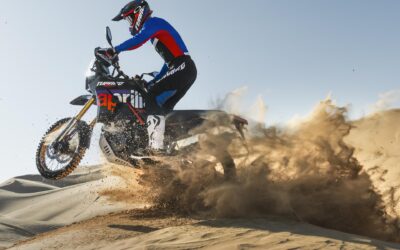
Aprilia Tuareg Rally The Twin-Cylinder Weapon for Real Off-Road RidersWhat happens when a serious off-road machine meets the mindset of a true adventure rider? You get the Aprilia Tuareg Rally, a...