
Giant Loop Round the World Panniers
Built Around the Load
On a long adventure ride, luggage becomes part of the motorcycle’s working structure. Every rut, compression, and stretch of corrugations puts attachments under repeated stress, and the load’s position affects how the bike responds beneath you. For riders carrying camping equipment, tools, and clothing across mixed terrain, the useful questions begin with how the bags are supported, how their contents are restrained, and what actually keeps water out.
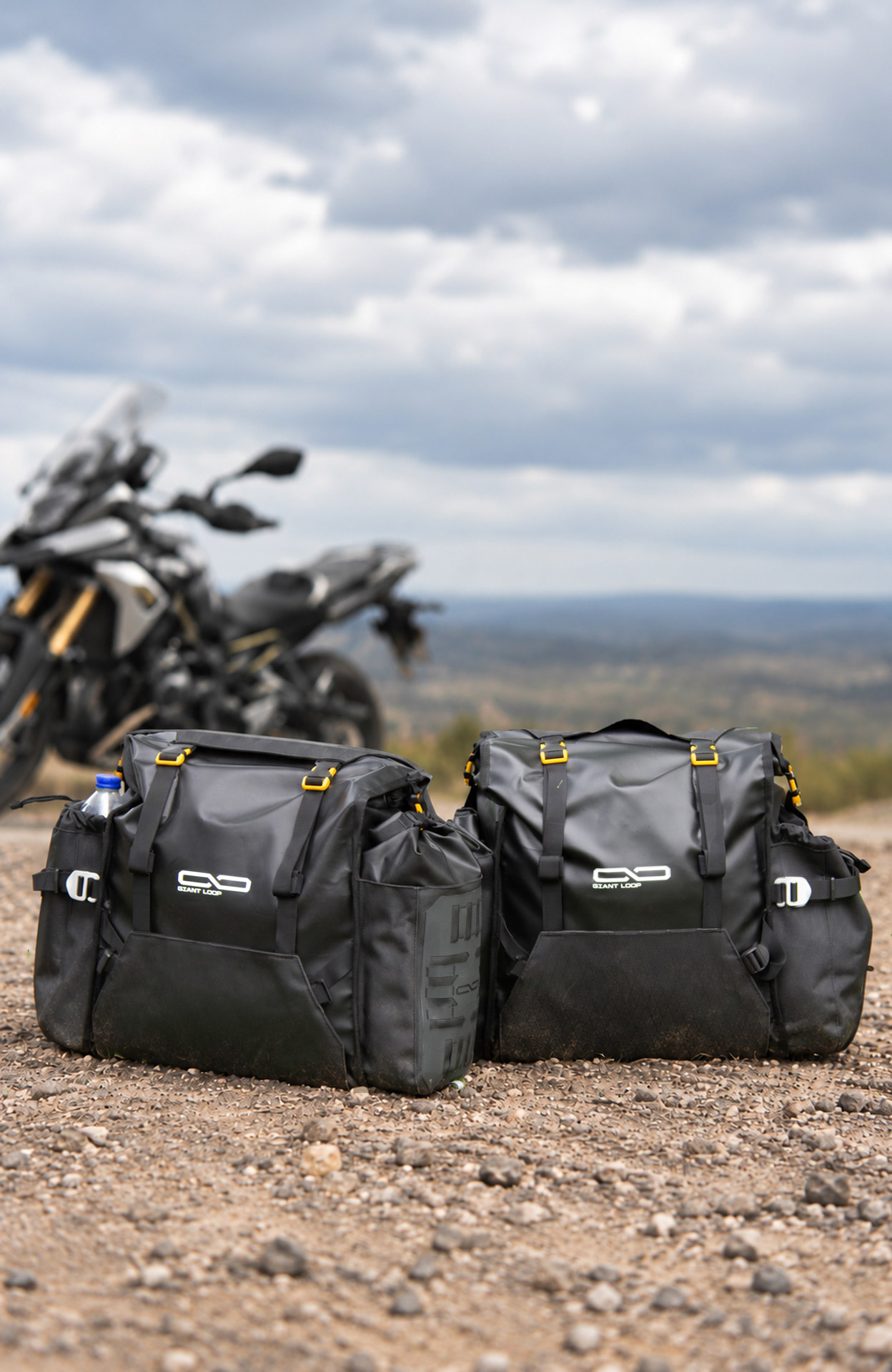
Giant Loop’s Round the World Panniers approach that job with flexible luggage bodies, internal reinforcement, and optional quick-release mounting hardware. Advertised capacity is 90 liters total, or 45 liters per side. Published weight is 10.4 pounds (about 4.7 kilograms), increasing to 14.8 pounds (about 6.7 kilograms) with the optional GL Pannier Mounts and hardware. Those figures give buyers two different starting points: the bags themselves and the mounted assembly, before accounting for the motorcycle’s luggage racks or anything packed inside.
Materials and Structural Reinforcement
The outer construction uses Giant Loop’s coated Bomb Shell fabric, sewn seams, and reinforced ballistic-nylon impact zones. Reflective trim adds visibility, while roll-top closures and side-release buckles secure the main openings. The distinction between the outer structure and the weather barrier matters: two included seam-sealed Dry Pods serve as waterproof inner liners. The outer bags provide the carrying structure and reinforce the protected load.
HDPE Internal Frame Sheet
Inside each pannier sits a removable high-density polyethylene, or HDPE, frame sheet. This detail matters for riders examining how a soft bag connects to a rigid rack. The sheet gives the mounting area a supported backing, rather than leaving the hardware attached through unsupported fabric alone. It lives inside a dedicated inset pocket, secured by an internal cover, and can be removed during installation to help establish the relationship between the bag, mounting hardware, and rack.
Mounting Hardware and Rack Installation
The supplied instructions describe frame sheets with six predrilled positions for the GL Pannier Mounts. However, predrilled reinforcement does not mean the complete pannier arrives ready to bolt together. The corresponding openings must still be made through the fabric on the wheel-facing side. With the frame sheet correctly seated, the installer locates the holes by touch and marks their positions before making openings just large enough for the mounting hardware.
Giant Loop describes using a soldering iron to melt those openings, with careful drilling also listed as an alternative. The internal frame-sheet cover must be held clear during this operation. For an owner fitting the bags at home, this is the stage that deserves patience: positioning and alignment establish where the pannier will sit on the motorcycle. Anyone using another manufacturer’s mounting system should follow that supplier’s instructions rather than assuming the GL pattern will apply.
Hardware Attachment and Quick-Connect Operation
The attachment uses six bolts with nuts and washers, with the bolts inserted from inside the pannier and the nuts positioned on the wheel side. Threadlocker is specified to prevent the bolts from vibrating loose. This small installation detail matters in adventure travel, where repeated vibration can expose weaknesses that go unnoticed on smooth pavement. The bags’ capacity is only useful when their connection to the motorcycle remains secure.
Once the GL mounts are installed, the routine becomes simpler. Holding the pannier by its handle, the rider places the hooks onto the luggage rack, opens the quick-connect clasp, and lets it click into position. Giant Loop then instructs the rider to lock the pannier to the rack, both for security and to prevent accidental disconnection. That locking function concerns the mounting connection; it should not be confused with securing the contents inside a flexible bag.
Stabilization Straps and Rack Compatibility
There is also provision for additional support. The instructions recommend routing the side straps through the luggage racks for maximum stability. Mechanically, that provides another way to restrain movement between the loaded bag and its support. How much difference it makes on corrugations or rough tracks will depend on the installation and load. Still, it is a useful adjustment to assess during setup rather than after the first demanding day.
Rack compatibility requires similar attention. The instructions identify an optional exhaust-side GSA adapter for BMW GS Adventure factory racks, listing the R1200 GS Adventure, R1250 GS Adventure, and F850 GS side racks. That is a specific fitment provision, not a reason to assume every BMW rack or every aftermarket frame will accept the same arrangement. The relevant combination is always the actual rack, mounting hardware, and motorcycle.
Packing Strategy and Weather Protection
Packing is integral to the design. Giant Loop advises placing the heaviest equipment as low as possible, preferably below the seat line, and balancing weight from side to side. For the rider, the practical implication is to decide where dense items belong before filling the remaining space. A large bag can accommodate bulky equipment, but available volume is not a payload rating or an invitation to fill every corner with heavy gear.
Roll-Top Closure versus Usable Volume
The closure system also introduces a trade-off between capacity and weather protection. The instructions call for three folds of the roll-top for maximum water protection. In drier conditions, a single roll allows the panniers and pockets to expand. Riders should therefore assess usable packing space with the closures configured for the weather they expect, leaving enough material to make the recommended folds.
Managing Abrasion and Water Resistance
The exterior roll-top pockets carry an explicit qualification: they are highly water-resistant, not waterproof. Moisture-sensitive equipment stored there needs its own protection. Inside the main bags, sharp or hard objects also require attention. Giant Loop recommends wrapping them to prevent vibration from wearing through either the pannier or its Dry Pod, suggesting tool rolls, clothing, or a protective sleeve made from an old inner tube for tire irons.
Technical Evaluation
The Round the World design gives experienced travelers several useful decisions to make: where to position the bags, how to reinforce their attachment, how to distribute the load, and which items belong behind the waterproof liners. Its technical appeal lies in that combination of removable internal reinforcement, a defined mounting procedure, and separate waterproof storage. The next measure is how those elements perform together over repeated days of riding, loading, unloading, and exposure, the part of the story our
Photos/Videos: BTA Media – Words: Thomas Ferrero
Related Articles
BMW GS Trophy 2026
BMW GS Trophy 2026 Six Days in the Wild Carpathians Adventure riding has a way of bringing people together. Different backgrounds, different languages, and different riding experiences often lead to...
Edgar Canet Claims His First RallyGP Victory in Morocco
The 27th Rallye du Maroc brought the world's leading rally-raid riders to southern Morocco from September 28 to October 3, for the fourth round of the 2026 World Rally-Raid Championship. Starting in...
Heavy Metal in the Taurus
Heavy Metal in the Taurus Where the Taurus Mountains Become a Playground for Adventure BikesLet's get one thing straight: nobody builds a 485-pound adventure bike to go scrambling up a goat trail....