
Chasing Dust Through Patagonia
Volcanoes, Gravel Roads, and Long Days Riding Out of Bariloche
Chapter 2
Every long ride has a turning point. A moment when the outward journey ends and the road quietly pivots, pulling you back toward where you started while somehow delivering you somewhere completely new.
For this one, that moment arrived somewhere south of San Martín de los Andes. The mountains were still there, familiar and enormous against the morning sky. But the rhythm of the ride had shifted. Days of pushing deeper into the backcountry eventually give way to something different. The trails start unwinding instead of tightening. The landscapes open instead of close in around you.
There were still river crossings ahead. Mechanical improvisations in the middle of nowhere. Fast gravel roads stretching across open terrain beneath that enormous Patagonian sky. And one final mountain waiting at the end of all of it. Patagonia had one more version of itself left to show us. The road headed south.
When Patagonia Slowed Us Down
The ride back south toward Bariloche the following day carried a completely different rhythm. After the intensity of the forest trails near Lanín and the abandoned mountain passes, the flowing pavement and gravel roads around the Seven Lakes region almost felt relaxing. Almost.
Because Patagonia never really allows you to stop paying attention for too long.
We followed Route 40 south before turning east toward Villa Traful, a quiet mountain village resting beside one of the most intensely colored lakes I have ever seen. Under the clear light of late morning, the water reflected deep shades of blue that almost looked artificial. We stopped briefly in town for ice cream before continuing higher above the lake toward one of the overlooks along the mountain road.
From up there, Lake Traful stretched across the valley surrounded by forests and steep mountainsides disappearing into the distance. Every stop somehow revealed another version of Patagonia completely different from the one we had seen only a few hours earlier.
Soon the mountains slowly opened into wider valleys and faster gravel roads carrying more traffic than the remote trails we had ridden during the previous days. By lunchtime we reached Confluencia once again, where a hot meal already waited for us before continuing south along Route 237 toward Bariloche.
Crossing Valle Encantado for a second time somehow felt completely new. Riding the valley from the opposite direction revealed different shapes in the rock formations towering above the Limay River. Shadows shifted across the cliffs differently in the afternoon light while the river reflected darker shades of blue beneath the massive stone walls surrounding the canyon. The landscape constantly changed depending on the angle of the road, almost forcing us to slow down once again simply to absorb everything around us.
Back near Villa Llanquín, we crossed the hanging bridge one more time before retracing our route toward Bariloche and the familiar comfort of the hotel waiting at the end of another long day in the saddle.
The following morning offered a rare change of pace. Instead of disappearing immediately into remote gravel tracks, we spent part of the day exploring the roads surrounding Bariloche itself. After days riding through isolated mountain terrain, seeing cafés, traffic, tourists, and busy streets again almost felt strange. Still, few places in Argentina blend mountain scenery and riding culture quite like Bariloche.
We wandered through the historic Civic Center before riding toward Cerro Catedral, the largest ski resort in South America, where the massive slopes rise above the city beneath the jagged skyline of the Andes. From there, the route carried us along the famous Circuito Chico and Colonia Suiza, weaving between lakes Nahuel Huapi and Perito Moreno while passing the iconic Llao Llao Hotel sitting high above the surrounding forest.
That afternoon could not have delivered better weather. The sky remained perfectly clear while sunlight reflected across the lakes with almost mirror-like intensity. Lunch took place at Cervecería Patagonia overlooking Lake Perito Moreno, one of those locations where nobody seems interested in checking the time or talking about schedules anymore. Cold local beer, good food, motorcycles parked outside, and endless Patagonian scenery tend to slow life down in the best possible way.
By then, the group already felt less like a collection of riders and more like old friends traveling together. The nights became louder too. Long dinners filled with local beer, oversized comfort food, and nonstop stories slowly turned into part of the daily ritual.
Back at Cervecería Blest, enormous milanesas napolitanas topped with fries and fried eggs covered the table, so large that four people could easily share a single plate. Between bites, laughter bounced across the restaurant as everybody relived crashes, close calls, missed turns, mechanical improvisations, and the endless jokes surrounding “Dimitri,” our supposedly inexperienced Swiss rider who continued attacking every gravel road like he had secretly raced Dakar for years.
Some trips are remembered for the places. Others stay with you because of the people sharing the ride.
Across the Open Steppe
Leaving Bariloche behind once again, the landscape slowly transformed as the mountains began fading into the distance and the wide open Patagonian steppe stretched endlessly toward the horizon. The dense forests and tight mountain trails of the previous days gave way to fast gravel roads, rolling terrain, and enormous empty spaces where visibility seemed to extend forever beneath the massive southern sky.
This was a completely different kind of riding. The pace increased naturally as the roads opened up across the plateau, allowing the Kove 450 Rally to stretch its legs through long sections of loose gravel and hard-packed dirt. Even at higher speeds, the bike remained remarkably stable across the washboard surfaces and fast flowing corners that define so much of Patagonia’s backcountry.
Throughout the morning we crossed countless streams and rivers flowing down from the Andes. Most were shallow and straightforward due to the unusually dry winter seasons the region had experienced during recent years. What could normally become difficult water crossings barely reached the lower sections of the wheels.
At least for most of us. Seb, one of the riders from the French Legion, discovered the exception while attempting one of the larger river crossings at a pace that probably felt perfectly reasonable only seconds earlier. Halfway across, his front wheel suddenly dropped into a deep hole hidden beneath the water and, almost instantly, both rider and motorcycle disappeared into the river.
For a brief moment, all anybody could see was splashing water. Then came the shouting, laughter, concern, and immediate rescue operation as several riders rushed into the river to pull both Seb and the Kove back onto dry ground. Somehow, he escaped completely unharmed besides soaked riding gear and a bruised ego that would certainly not survive the rest of the trip without repeated reminders from the group.
The bigger question was whether the motorcycle would survive. Within seconds, Guille and Luchi were already working on the bike alongside Juanmi. The seat came off. The air filter was removed. Several riders lifted the Kove nearly vertical to help drain water from the engine before rolling the rear wheel backward in gear to force any remaining water out of the cylinder.
Watching the whole recovery process unfold in the middle of nowhere felt like witnessing a Dakar bivouac improvisation deep in Patagonia. After installing a fresh air filter from the endless inventory stored inside the support truck, they hit the starter. The engine fired almost immediately.
Cheers erupted across the riverbank while Seb stood there completely soaked and laughing at the absurdity of the entire situation. Against all expectations, both rider and motorcycle continued the trip as if nothing had happened. By lunchtime, most of his gear had already dried beneath surprisingly warm skies and the total absence of Patagonia’s famous wind, something we still could not quite believe after several days riding across the region.
Somewhere along that stretch, another unexpected piece of Patagonia’s history began appearing beside the trail: old railway tracks. Again and again, our route crossed the narrow gauge rails of La Trochita, officially known as the Old Patagonian Express, the legendary steam train that once connected isolated settlements across Río Negro and Chubut Provinces.
Built in the early twentieth century, the railway became essential for transporting supplies, livestock, and passengers through some of the most remote areas of Patagonia. Even today, parts of the line still operate as a living museum where old steam locomotives continue hauling wooden railcars heated by small wood stoves exactly like decades ago.
Eventually curiosity got the better of me. At one crossing, I turned off the trail and started riding directly between the rails for a short stretch, instantly feeling like a kid doing something he probably should not be doing. Completely unnecessary. Completely worth it.
A little farther down the route, we started looking for shade or any decent place to stop for a simple picnic lunch. The sandwiches and cold drinks were coming behind us in the support truck, and by then the Patagonian sun was starting to feel stronger. That search eventually led us to a small homestead sitting alone in the middle of the steppe. A few trees near the house provided enough cover from the afternoon sun for the group to stop and unpack lunch while dust slowly settled around the parked motorcycles.
Out there, places like that seem impossible. Hours from major towns, surrounded by endless open terrain, with nothing but gravel roads and distant mountains stretching toward the horizon, somebody still manages to build a life in complete isolation.
As soon as the owner saw the group arriving, he immediately insisted we use the shaded area near his house to rest more comfortably while waiting for the support truck carrying lunch supplies and cold drinks. That kind of hospitality stays with you. A man offering the little he has to a group of complete strangers who suddenly appeared out of nowhere in the middle of Patagonia.
Not long afterward, Juanmi finally arrived driving the truck. That was when we noticed one of the Kove motorcycles strapped in the back. Apparently “Dimitri” had been riding exactly the same way he had ridden every gravel section so far: aggressively fast and with far more confidence than somebody supposedly new to off-road riding should realistically possess. Somewhere along a rocky corner, he clipped a large stone hard enough to break the exhaust mount completely, leaving the muffler hanging loose from the motorcycle.
Naturally, this immediately turned into entertainment for the rest of the group. The situation became even better once we realized the local homeowner happened to own a welder.
Right there in the middle of nowhere, Juanmi improvised a new exhaust bracket using an old metal food can while the homeowner helped weld everything back together beside the house. Within a short time, the Kove was fully repaired and ready to continue south as if nothing had happened. It felt almost absurd. Hundreds of miles from major cities, surrounded by empty steppe, somehow we still found exactly the tools and help needed to keep the trip moving.
At the same time, the support truck quietly kept us connected to the outside world through a satellite internet system mounted above the cab. One moment we were watching improvised welding repairs beside a remote Patagonian homestead, and minutes later riders were checking messages and uploading photos from the middle of nowhere. Adventure travel in 2026 apparently comes with Wi-Fi in the steppe.
After lunch, the route continued south toward El Maitén, home to the main workshops of La Trochita, where the historic steam locomotives are still maintained using many of the original techniques and handmade replacement parts required to keep the narrow gauge railway alive.
Fuel stop. Quick snacks. More jokes. Back on the bikes.
From there, secondary roads carried us toward El Bolsón before the mountains slowly began returning to the horizon once again. The route climbed west through lower mountain passes and forests before reconnecting with Route 40 for the final approach toward Cerro Perito Moreno and the small ski area known as Laderas.
That night’s hotel sat completely alone at the base of the mountain. Incredibly, the property had opened exclusively for our riding group despite being completely outside ski season. After more than 195 miles (315 kilometers) of gravel roads, river crossings, mechanical improvisations, and endless Patagonian emptiness, the warm rooms and quiet mountain setting felt strangely luxurious after so many miles of dust and isolation. By then, nobody needed help falling asleep.
Beneath the Ice of Tronador
The final riding day arrived quietly. After several days filled with dust, gravel, river crossings, and long hours deep in Patagonia, the atmosphere around breakfast felt different that morning. Nobody needed to say it out loud. We all knew the trip was slowly approaching its final miles.
Some riders from the group planned to head directly toward Bariloche for the opening round of the MXGP World Championship taking place that weekend. Sergio and I decided to spend one last day exploring the mountains instead, riding toward Cerro Tronador, the highest peak in the region at 11,453 feet (3,491 meters).
The mountain takes its name from the constant thunder produced by massive chunks of ice breaking away from its glaciers high above the valley. Long before seeing the summit itself, we would already understand exactly why locals named it Tronador.
Access to the mountain follows a narrow road carved directly into the side of the valley, so tight in places that traffic only flows in one direction depending on the hour of the day. We arrived just as the road opened for uphill traffic, giving us the perfect opportunity to enjoy the climb without worrying about oncoming vehicles around the blind corners.
That road alone would have justified the ride. The route twisted above Lake Mascardi through dense forest, cliffs, waterfalls, loose rock, gravel, and exposed mountainsides where the road seemed barely carved into the landscape itself. Every corner revealed another view of Patagonia unfolding beneath us until finally the massive white summit of Tronador appeared ahead against one of those impossibly deep blue skies only the Andes seem capable of producing.
Even after days surrounded by giant landscapes, the mountain still managed to stop us in our tracks.
We reached Pampa Linda, the small mountain outpost sitting at the base of Tronador surrounded by campgrounds, lodges, and forests fed by glacial rivers descending from the upper slopes. From there, we continued toward one of the strangest natural formations in Patagonia: Ventisquero Negro.
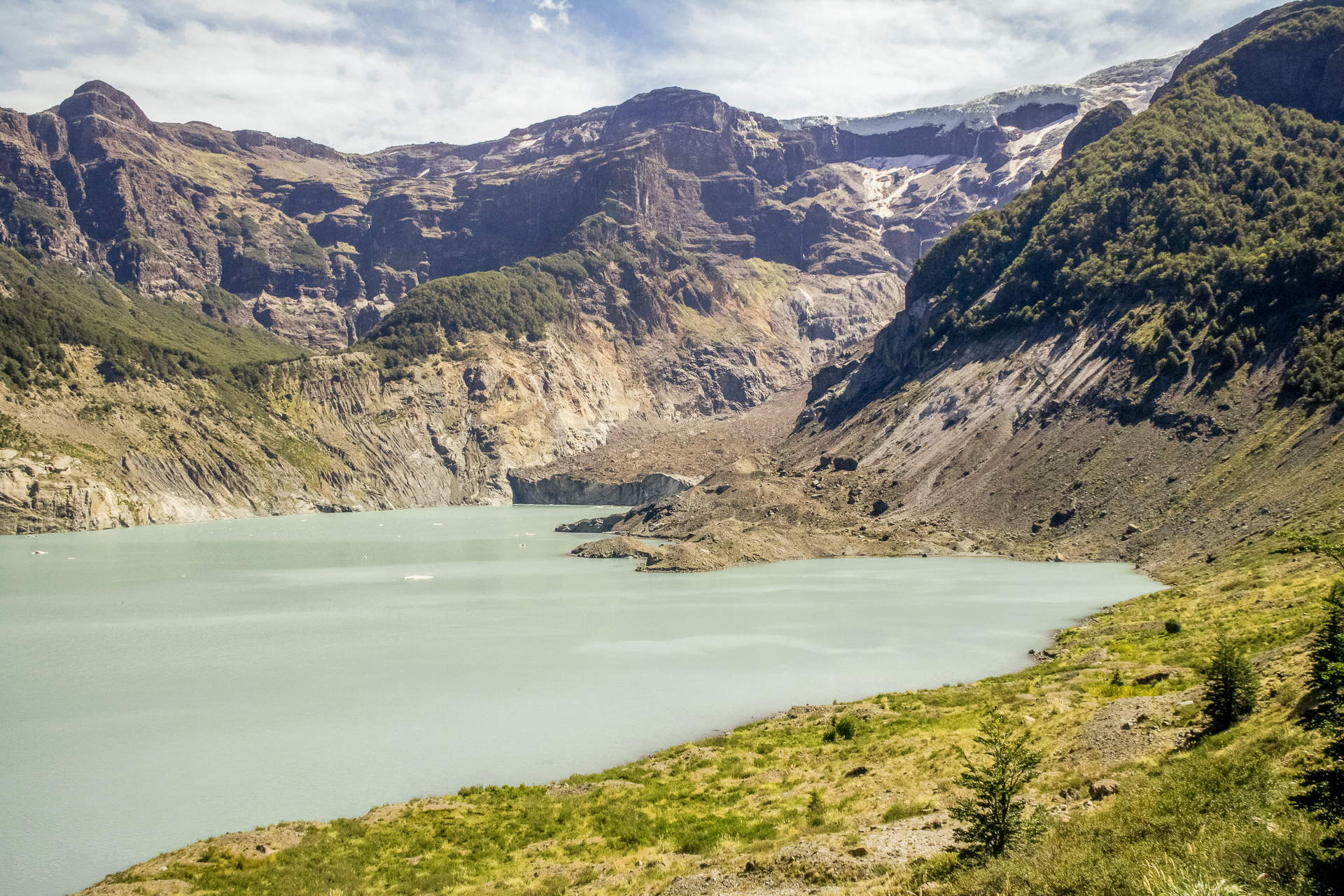
Unlike most glaciers, the ice here appears almost black due to the volcanic sediment, sand, and rock dragged down the mountain over centuries by the glacier itself. Massive chunks of ice collapse from higher glaciers nearly 650 feet (200 meters) above, carrying dark debris that becomes compressed into a moving wall of blackened ice descending toward the valley below.
At the base of the glacier, floating black icebergs drift silently across bright turquoise water beneath the cliffs. The contrast looked almost unreal.
While standing near the overlook, several deep thunderous cracks echoed through the valley as enormous sections of ice collapsed somewhere high above the mountain. Seconds later, the sound rolled across the landscape like distant artillery fire. That was Tronador speaking. We stayed there longer than planned, simply watching the glacier and listening to the mountain.
Later, we rode back toward Pampa Linda just before the road reopened for downhill traffic later that afternoon. With no incoming vehicles allowed during the descent window, the ride back down the mountain turned into one final reward before returning to civilization: one last stretch of flowing corners through Patagonia.
On the way down from Tronador, we took the nearby detour to Cascada de los Alerces, another classic stop inside Nahuel Huapi National Park and almost impossible to skip when riding that area. Emerald colored water from the Río Manso crashed roughly 65 feet (20 meters) into a narrow rocky gorge surrounded by dense forest and ancient alerce trees that have survived in the region for centuries.
It felt like the perfect final image for the trip. Water. Forest. Mountains. Silence.
At last, the road carried us back toward Bariloche one last time, where the rest of the group slowly reunited at the hotel throughout the evening. Riding gear piled up in hallways. Dust covered helmets rested beside luggage bags waiting for flights home the following morning. Stories from the previous days bounced between tables during our final dinner together while everyone tried squeezing a few more laughs out of the trip before reality returned.
Trips like this always seem to end the same way: too fast.
But somewhere between the volcanic trails near Lanín, the endless gravel roads across the steppe, the glaciers of Tronador, and the laughter shared every night after the riding stopped, Patagonia quietly works its way into you. And long after the dust disappears from the riding gear and the motorcycles are parked back in the garage, part of you is still out there somewhere, following a gravel road beneath the Patagonian sky.
Words by: Mike de la Torre – Photo Credits: Machi Romanelli, Mike de la Torre
Articles in this issue
Abu Dhabi Desert Challenge 2025
Five Days of Sand, Sweat and SurvivalThere’s a certain silence in the desert that speaks louder than engines. It’s the kind of silence that wraps around your helmet as you stare into a horizon that...
Patagonia Between Trails and Friends
A Pact Between Friends and Mountains“You have to come to Patagonia.” After all, I’d already taken Simon Cudby and Randy Commans, also known as Offroadunderground, through the dusty trails of...
A Loop Through Spain’s Desert Trails
Where the Silence Smells Like DustIt was still dark when I unzipped the tent and stepped into the chill. My boots sank slightly into the dry earth, the kind that holds yesterday’s stories in the...
The Journey Across the Americas
From Ushuaia to Alaska Chapter 7 - Mexico City to LADiego Rosón’s Epic Adventure on a Royal Enfield Classic 500After thousands of miles already behind him, Diego’s journey was far from over. In this...

2026 BMW R 12 G/S
2026 BMW R 12 G/S Built for Dirt, Born from Legacy.There are motorcycles that spark curiosity, and then there are those that stir something deeper, something primal. The kind of feeling that starts...
Aprilia Tuareg Rally
Aprilia Tuareg Rally The Twin-Cylinder Weapon for Real Off-Road RidersWhat happens when a serious off-road machine meets the mindset of a true adventure rider? You get the Aprilia Tuareg Rally, a...