
Chasing Dust Through Patagonia
Volcanoes, Gravel Roads, and Long Days Riding Out of Bariloche
Patagonia has always carried a magnetic pull for motorcycle travelers. Endless gravel roads, snow covered volcanoes, deep blue lakes, remote mountain passes, and the kind of landscapes that seem built for two wheels. Northern Patagonia, especially around San Carlos de Bariloche and San Martín de los Andes, offers an almost overwhelming combination of terrain and scenery capable of turning even the shortest ride into a full blown adventure.
This journey through Argentina’s Lake District brought together everything that makes riding in Patagonia unforgettable. Long days crossing remote backcountry trails, volcanic landscapes near Lanín, fast gravel roads through the open steppe, glaciers beneath Cerro Tronador, mechanical improvisation in the middle of nowhere, and the constant laughter shared between riders after the helmets came off each evening. With Big Trail Argentina handling the logistics and a fleet of Kove 450 Rally motorcycles beneath us, all that remained was to ride deeper into Patagonia and let the road take care of the rest.
A few loose rocks bounced off the skid plate as the trail narrowed into a single lane cutting through the Patagonian backcountry. Dust hung suspended in the cold morning air while the rest of the group disappeared ahead between low hills and scattered bushes. Barely ten minutes after leaving the pavement behind, something started feeling odd through the handlebars of my Kove 450 Rally.
Front flat tire.
I rolled the bike to the side of the trail while the others continued north toward the mountains. Within minutes, Guille stopped with me until Juanmi arrived driving the support truck. For them, it was just another quick repair in the middle of nowhere. For me, it would have easily turned into an hour of tools, tire irons, dust, and frustration. Instead, fifteen minutes later, the wheel was back on, the tire inflated, and I was riding again through one of the most remote corners of northern Patagonia.
Sometimes a little bad luck opens the perfect door.
The delay left a huge gap between me and the rest of the riders. No dust cloud in front of me. No traffic. No distractions. Just the empty trail stretching into the distance and the chance to finally let the Kove run free across the loose gravel and fast Patagonian terrain.
Out there, dust becomes part of the language of riding. Too close to the rider ahead and visibility disappears completely. Stay back for a few seconds and the road opens again. At the same time, those floating clouds of dirt become an early warning system, letting you know another vehicle is approaching long before you can actually see it. Small details learned after years of riding off road.
The trail twisted north following sections of the Pichi Leufu River through open valleys and isolated ranch land. Eventually I caught up with the rest of the group near a remote intersection somewhere deep in Río Negro Province. Helmets came off, laughter started flowing again, and the whole pack regrouped before continuing west toward Villa Llanquín.
By then, Patagonia had already done what it always does.
It pulls you in fast.
The strange thing is that less than twenty four hours earlier, Sergio and I were still in Buenos Aires loading riding gear into airport luggage carts before boarding our flight south toward the mountain city of San Carlos de Bariloche, that would become our basecamp for the next several days of riding across northern Patagonia. This time we joined one of the tours organized by our friends at Big Trail Argentina, with Guille and Pato Marelli handling the entire operation, logistics, support truck, accommodations, and even the motorcycles themselves.
And honestly, arriving to find every bike lined up outside the hotel already prepared for the trip changes the whole rhythm of the experience. No late night wrenching. No rushing through final adjustments. No stress before departure. Just riding.
March in Patagonia can shift moods fast. Warm sunny afternoons above 77°F (25°C) can suddenly turn into cold mornings filled with rain, heavy clouds, and temperatures dropping near 41°F (5°C). Layers become part of survival down there, especially when long days in the saddle take you far away from pavement and deep into the mountains.
For this ride, I packed my Alpinestars ST 7 Gore Tex gear, along with my trusted Tech 7 Enduro boots and Supertech M10 helmet. Extra gloves, neck gaiters, and thermal layers quickly proved worth carrying. Patagonia has a way of making you use everything you bring.
Back at the hotel parking lot in Bariloche, the group slowly came together while everyone sorted gear and loaded motorcycles for the days ahead. I mounted a set of Giant Loop Mojavi saddlebags on the Kove, carrying extra layers, water, and the small essentials that always end up needed somewhere along the trail. A Giant Loop Klamath tail rack kept my camera within reach, while an SP Connect anti vibration mount handled navigation duties through the endless washboard gravel roads waiting ahead.
All my riding gear had made the trip south packed inside a massive 150 liter USWE roller bag. Big enough to carry everything needed for unpredictable Patagonian weather, yet practical enough to drag through airports, hotel hallways, and parking lots full of dusty motorcycles.
The best part was knowing we could focus completely on riding. No need to carry tools, spare tubes, or even think too much about possible mechanical problems. Juanmi constantly stayed one step ahead of everything. Every stop became a quick service station where chains were lubricated, loose bolts tightened, air filters cleaned, and bikes checked before heading back into the dirt. Alongside being the group mechanic, he also drove the support truck that followed our route across Patagonia loaded with tools, spare tires, fuel, food, and enough equipment to keep the entire expedition moving.
My riding partner for the trip was my friend Sergio, someone I had already shared plenty of miles with over the years. Around us, the rest of the crew slowly revealed their personalities as the days unfolded. There was the “French Legion,” a group of riders who had traveled all the way from France to experience Patagonia on two wheels, along with Vincent, the quiet Swiss rider who claimed he had little off road experience despite riding like a Dakar veteran every time the trail opened up. Before long, Juanma had already renamed him “Dimitri,” convinced he was actually a Russian spy sent to investigate why everybody seemed so happy in Argentina.
The laughter around fuel stops, lunches, and hotel parking lots slowly became part of the trip itself. Machi, our official photographer and one of Big Trail’s most charismatic characters, quickly became part of that same rhythm. He was always moving around the group with a camera in hand, hunting for light, angles, and dust clouds, while somehow still finding time to throw in a joke, a comment, or one of those perfectly timed remarks that kept everyone laughing between sections.
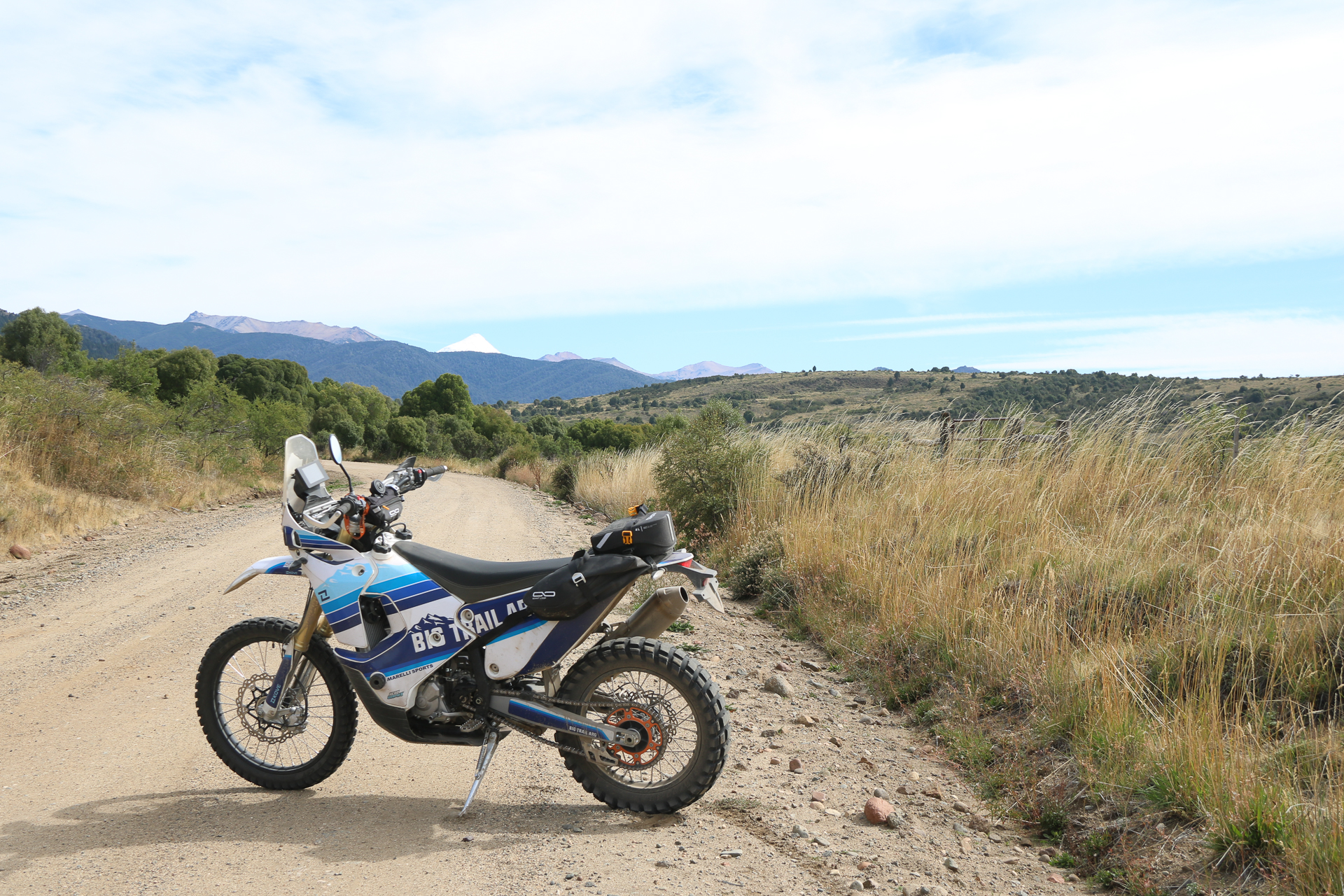
The following morning, we left Bariloche heading north toward San Martín de los Andes, another beautiful mountain town resting along the shores of Lake Lácar. But taking the direct paved route was never part of the plan.
Instead, Big Trail Argentina guided us east through secondary roads before disappearing completely into remote gravel tracks cutting across isolated Patagonian ranchlands and narrow mountain passes following sections of the Pichi Leufu River.
That was where the real trip began.
By the time we reached the regroup point near Villa Llanquín, helmets were coming off and everybody was already talking over each other about river crossings, loose corners, near misses, and the kind of small moments that somehow become unforgettable once you are deep into a ride like this. Patagonia tends to do that. A simple gravel road suddenly turns into a memory you know will stay with you for years.
Villa Llanquín itself felt tiny against the scale of the surrounding landscape. Sitting quietly along the Limay River, the little settlement seemed almost frozen in time. What immediately caught my attention was how low the river level looked. Locals had already mentioned the region had experienced very light snowfall during the previous winters, something that became increasingly obvious throughout the trip as we crossed rivers, streams, and lakes across northern Patagonia.
To cross the Limay, motorcycles rolled one at a time over a narrow hanging footbridge while the support truck floated across separately aboard a tiny raft capable of carrying only two vehicles. Standing there waiting for my turn to cross, watching the river flow quietly below the wooden planks while motorcycles disappeared one by one toward the opposite shore, felt like one of those scenes that perfectly captures adventure travel in South America.
Once back on pavement, we joined Argentina’s legendary Route 237 heading north. At first, I assumed it would simply be another transit section connecting dirt roads deeper into the mountains. Patagonia had other plans.
The road immediately began twisting alongside the Limay River through a place known as Valle Encantado, or Enchanted Valley, and honestly, the name makes perfect sense the moment you ride into it. Massive rock formations rise unexpectedly from the landscape, shaped by wind and erosion into strange silhouettes towering above the river. Some already carry names given by locals over the years, including El Dedo de Dios, or “The Finger of God,” a narrow vertical stone formation pointing dramatically into the sky, and a massive natural amphitheater carved into the cliffs above a bend in the river, the kind of place that makes you wonder whether nature had been studying ancient Roman theaters all along.
Normally, a road filled with flowing corners would tempt me to pick up the pace and enjoy the riding itself. This time was different. Between the deep blue water of the Limay, the strange rock formations, and the changing colors spreading across the valley walls, I found myself constantly slowing down just to absorb the scenery around us.
That combination of river, mountains, forests, and open Patagonian terrain felt completely unique.
Further north, we reached Confluencia, where the Traful River merges into the Limay. Again, the unusually low water levels stood out immediately while crossing the bridge above the river. From there, we left the pavement behind once more and headed west into Paso Córdoba, one of those remote mountain roads that quietly becomes a highlight of the entire trip without anybody expecting it beforehand.
The gravel climbed steadily into the mountains through isolated valleys and wide open ridgelines under heavy gray clouds that threatened rain all afternoon but never fully delivered. The temperature stayed cool, yet one thing remained strangely absent the entire day.
Wind.
Anyone who has spent time riding Patagonia knows how unusual that feels.
At the highest section of the pass, we stopped for photos surrounded by endless mountains, cold air, and complete silence except for the occasional ticking sound of cooling motorcycle engines. Moments like that are difficult to explain properly to people who have never experienced long days off road with a good group of riders.
The kind of silence only the road can teach.
From there, the trail descended toward Caleufú before turning west again toward Lake Filo Hua Hum, another hidden corner of Patagonia surrounded by dense forest and crystal clear water. Waiting for us near the lakeshore was a small restaurant and campground where the Big Trail crew already had lunch prepared.
Hot milanesas with mashed potatoes and fresh tortas fritas never tasted so good after hours riding through cold mountain roads.
With full stomachs and dusty motorcycles parked outside, nobody seemed particularly interested in leaving anytime soon.
Before long, the road kept pulling us north once again.
The afternoon ride toward San Martín de los Andes carried that perfect end of day feeling that only arrives after hours spent deep in the mountains. The pace slowed naturally. Conversations at fuel stops became louder. Riders started replaying moments from the trail while the landscapes rolled by beneath the soft afternoon light of northern Patagonia.
By then, I was already completely sold on the Kove 450 Rally. The motorcycle felt perfectly at home on these roads, especially once the pavement disappeared and the terrain turned loose and unpredictable. Around us, the rest of the group seemed equally satisfied after a full day crossing mountain passes, remote gravel roads, hanging bridges, and endless Patagonian backcountry trails.
As usual, Juanma somehow managed to keep everybody laughing every time helmets came off. Whether during fuel stops, lunch breaks, or random pauses in the middle of nowhere, he always seemed to have another ridiculous comment ready at exactly the right moment.
We finally rolled into San Martín de los Andes later that afternoon after covering roughly 158 miles (255 kilometers) of some of the best riding imaginable.
And honestly, the heated hotel pool waiting for us after a full day in riding gear felt almost as rewarding as the ride itself.
Soon we were all gathered by the heated pool with cold drinks in hand, letting the stories from the day start flowing once again. The tension slowly disappeared from tired shoulders while the mountains surrounding San Martín faded into evening light beyond the hotel.
Later that night, pizzas, beer, and nonstop laughter carried the group well into the evening.
The kind of ending every great riding day deserves.
Into the Shadow of Lanín
The following morning, we rolled out of San Martín de los Andes heading north once again, this time toward one of the most iconic volcanoes in all of Patagonia. A short section of Route 40 soon gave way to smaller roads leading toward Lake Lolog and later Lake Curruhué, where the landscape somehow became even more dramatic than the day before.
That is the thing about this corner of Argentina.
You are never too far from water.
Deep blue lakes appear everywhere between the mountains, surrounded by dense forests painted in every shade of green imaginable. Under the morning sunlight, the surface of the water reflected the sky with almost unreal intensity while cold air drifted down from the higher elevations surrounding us.
And then, for the first time that morning, Volcán Lanín appeared above the trees.
Rising to 12,388 feet (3,776 meters), its massive snow covered cone dominated the horizon with a presence impossible to ignore. What makes Lanín feel so imposing is the way it rises abruptly from the surrounding terrain instead of hiding among taller mountain ranges. One moment you are riding through forested valleys and lakeshores, and the next, the volcano suddenly towers above everything around it like a frozen sentinel watching over northern Patagonia.
We passed Laguna Verde, where lunch would later be waiting for us, but for now the route continued deeper into the mountains toward the Chilean border and the abandoned Carirriñe Pass.
That section of trail ended up becoming one of my favorite rides of the entire trip.
The road narrowed into a twisting ribbon of dirt weaving through dense forest, constantly changing elevation while carving along the shores of Lake Epulafquen. Tight corners, loose gravel, tree roots, short climbs, and quick descents kept everybody fully focused while occasional openings through the trees revealed more distant views of Lanín rising above the landscape.
Every mile seemed to pull us farther away from civilization.
Then the scenery changed instantly.
Without warning, the forest opened into a massive volcanic field known locally as El Escorial, where ancient lava flows once spilled down from the volcano thousands of years ago. The dark hardened rock stretched across the mountainside in sharp contrast against the surrounding green forest, creating one of the strangest landscapes of the entire journey. It looked raw. Untouched. Almost recent, despite the centuries that had passed since the eruption shaped this valley.
Minutes later, the trail disappeared back into the trees.
By then, some riders in the group had completely surrendered to the rhythm of the terrain. Luchi, Juanma, Ocean, and Ale quickly vanished ahead, riding with the kind of speed and confidence that only comes from years of enduro and motocross experience. Sergio and I stayed behind at our own pace, enjoying every corner, every climb, and every section of flowing trail through the forest.
Honestly, it was difficult to wipe the smile off my face inside the helmet.
That narrow mountain trail felt like the perfect environment for the Kove 450 Rally. Light, agile, predictable, and incredibly fun once the pace picked up on loose terrain. Somewhere along those forest sections, I realized I had completely stopped thinking about the motorcycle itself and simply gave myself over to the ride.
That is usually a very good sign.
The trail finally delivered us to the abandoned hot springs of Termas de Lahuen Co, where the unfinished remains of an old hotel project still sit hidden deep in the mountains. Weathered wooden walkways connected several natural hot spring pools surrounded by dense forest and volcanic rock.
And of course, nobody needed much convincing to climb into the steaming water after hours riding dusty mountain trails.
For a while, the only sounds came from laughter, splashing water, and stories bouncing between riders relaxing in the pools while helmets and riding gear waited nearby under the Patagonian sun.
Until hunger reminded us there was another reason to head back toward Laguna Verde.
Waiting for us at the campground, Franco and the Big Trail crew had prepared thick choripán sandwiches and grilled steaks that disappeared almost instantly once the first riders arrived. The French Legion had apparently reached lunch before the rest of us and already looked fully committed to the mission by the time Sergio and I walked in.
Nobody complained.
After several hours riding through cold mountain trails, volcanic terrain, and dense forest, the combination of grilled meat, hot food, and the black volcanic beaches surrounding the lake felt close to perfect.
While most of us relaxed near the shoreline enjoying the afternoon sun, Juanmi once again moved quietly between motorcycles checking chains, cleaning air filters, and tightening bolts loosened by endless miles of washboard gravel and rocky trails.
Somebody always has to keep the expedition moving.
The ride back to San Martín de los Andes felt lighter, with full stomachs, warm sun, and the kind of satisfaction that comes after one of those days where everything seems to line up. We stopped again near Lake Lolog for a short break at a small lakeside café, taking in one last view of the water before returning to town.
Back at the hotel, the ritual repeated itself in the best possible way. Heated pool, cold drinks, and a full group replaying every corner, every laugh, and every fast section from the day.
That night, dinner raised the bar again with a classic Argentine parrillada in San Martín. Beef, pork, chicken, chorizo, morcilla, chinchulines, and more food than any reasonable group of riders should have been able to finish. Somewhere in the middle of the feast, one of the waitresses looked at our table shaking her head and laughing before saying it looked like we were hungrier than abandoned children.
Considering the amount of riding we had packed into the day, nobody at the table argued with her.
Two days deep into northern Patagonia and the mountains had already rearranged something inside the trip. The volcanoes, the forest trails, the hot springs hidden far beyond any paved road. None of it had been planned in precise detail, and somehow that was exactly the point.
Lanín still dominated the horizon as we rode back toward San Martín that evening, its snow-covered cone burning orange in the last light of the afternoon. A reminder, perhaps, that the best landscapes never let you leave quietly.
The first half of the journey had delivered everything Patagonia promised. Long days in the saddle. Remote trails that asked more than expected. And the kind of laughter shared between riders that only accumulates after miles of shared dust and cold mountain air.
Now the road was about to change direction entirely.
South. Back through the mountains. Across the open steppe. And toward one final destination waiting silently at the end of it all.
Words by: Mike de la Torre – Photo Credits: Machi Romanelli, Mike de la Torre
Articles in this issue
Abu Dhabi Desert Challenge 2025
Five Days of Sand, Sweat and SurvivalThere’s a certain silence in the desert that speaks louder than engines. It’s the kind of silence that wraps around your helmet as you stare into a horizon that...
Patagonia Between Trails and Friends
A Pact Between Friends and Mountains“You have to come to Patagonia.” After all, I’d already taken Simon Cudby and Randy Commans, also known as Offroadunderground, through the dusty trails of...
A Loop Through Spain’s Desert Trails
Where the Silence Smells Like DustIt was still dark when I unzipped the tent and stepped into the chill. My boots sank slightly into the dry earth, the kind that holds yesterday’s stories in the...
The Journey Across the Americas
From Ushuaia to Alaska Chapter 7 - Mexico City to LADiego Rosón’s Epic Adventure on a Royal Enfield Classic 500After thousands of miles already behind him, Diego’s journey was far from over. In this...
2026 BMW R 12 G/S
2026 BMW R 12 G/S Built for Dirt, Born from Legacy.There are motorcycles that spark curiosity, and then there are those that stir something deeper, something primal. The kind of feeling that starts...
Aprilia Tuareg Rally
Aprilia Tuareg Rally The Twin-Cylinder Weapon for Real Off-Road RidersWhat happens when a serious off-road machine meets the mindset of a true adventure rider? You get the Aprilia Tuareg Rally, a...