
Gravel, Pines, and Scratches. Chasing the California North BDR
When we start planning a BTA trip, the word that always hangs in the air is “adventure.” It’s the compass needle. Adventure, at least according to the Oxford dictionary, means something unusual, exciting, maybe even dangerous. In practice, it means long hours with a map, trying to convince ourselves that somewhere out there, there’s still a road worth chasing. Usually, that search has us spinning the globe, Peru, Mongolia, Morocco, places that come with exotic promise and logistical headaches.
This time, though, we only had two weeks. Not nearly enough for Africa or the Andes. So I sat with Mike and Philip, staring at Google Earth like a trio of stranded astronauts looking for a landing zone. We threw around big names, faraway places. And then I remembered a conversation with Inna Thorn from Backcountry Discovery Routes. She’d made a bold claim: that California, of all places, still held the kind of terrain that could keep us guessing.
California? To me, that was a theme park with traffic. Beaches clogged with tourists, wine tours, and selfie sticks on Highway 1. Hardly the “unusual” we were after. But Inna insisted the state still had backcountry worth the ride. With nothing to lose but time and tires, we decided to test her theory. What we found was not the California on postcards, but something else entirely. Something raw enough to remind us why we chase adventure in the first place.
The Riders & The Machines
On a trip like this, the human element can make or break the ride. You need a small, tight crew that knows each other’s strengths and weaknesses, a group compact enough to adapt quickly when things go wrong. Normally, we ride in pairs. But since this trip would be unsupported, we added a third man to the roster. If one of us went down, another could stay behind while the third went searching for help. With no cell service in most of the places we’d be riding, that felt like a good safety net.
So it was the three of us: Mike, Philip, and me. We’ve known each other for years, with enough shared miles and past mishaps to trust one another when stress hits. The familiarity brought its own comfort; we didn’t need to explain, we just rode.
The same way we carefully select our team, we select our motorcycles. For this ride, we had 2,000 miles ahead of us: long stretches of tarmac, loose gravel, steep climbs, and the inevitable rocky punishment California’s backcountry had in store. After some debate, we decided KTM was the brand that fit the job.
When we told Chris at KTM about our plan, he made sure three machines were waiting: a 2024 KTM 1290 Super Adventure R, a 2024 1290 Super Adventure S, and a 2025 KTM 790 Adventure.
Before pointing north, we swapped all three bikes to Dunlop Trailmax Raid tires. Rated 60/40 for dirt versus tarmac, they were exactly what we needed for a ride that would throw us from highway heat into unpredictable tracks. A different choice, and we might have been in trouble.
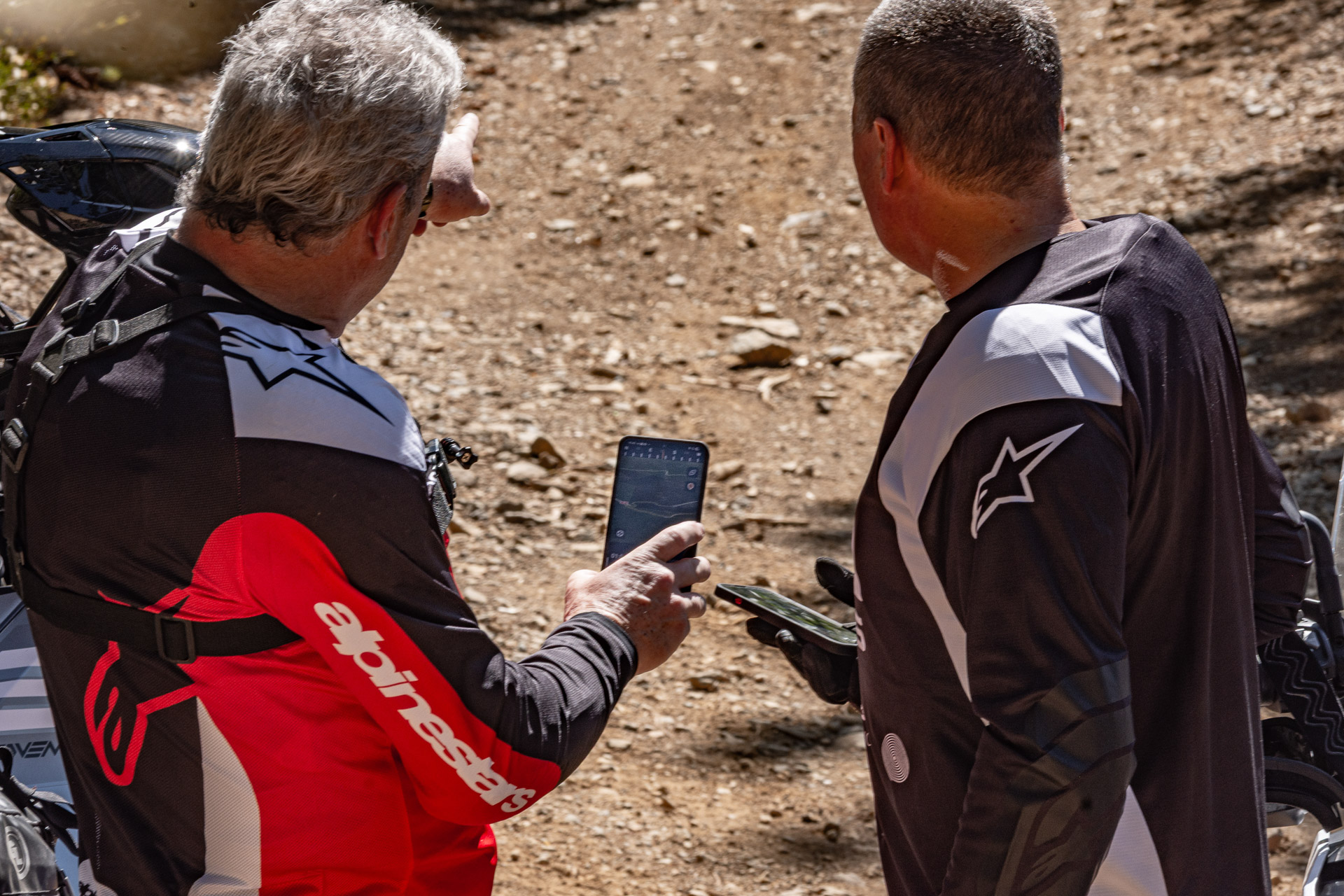
Navigation was just as critical. We built our route on the OnX Offroad app, modifying the GPX files supplied by the Backcountry Discovery Routes team to suit our timing and goals. Each of us ran the maps on our phones, mounted to the bars with SP Connect systems, the anti-vibration mounts were a lifesaver, keeping our phones from shaking themselves to death on endless rocky sections. MagSafe charging kept them alive through long days in the saddle.
For luggage, we went with Giant Loop’s Reckless system. The 1290’s carried Coyote Saddlebags and Siskiyou Panniers, while the 790 ran a Mojavi Saddlebag. We added tank bags and a Klamath Tail Rack Pack each, just enough to carry tools, water, first-aid, tire kits, compressors, and the bare minimum of clothes. Every item had its place, and we had no support vehicle to fall back on if something was forgotten.
Gear was equally important. We wanted maximum protection without cooking in California’s summer heat. At Alpinestars, we met Danielle, who knows California’s backcountry as well as anyone. Her advice on how to kit up for heat, rock, and surprise weather was sharp and direct, and it turned out to be exactly what kept us in one piece. For helmets, we all wore Alpinestars Supertech M10s, paired with Vision 3 goggles (tinted and clear lenses ready for changing light). Body armor ranged from Bionic Tech V3 and Bionic Action V2 protection jackets to Bionic SX-1 and Pro Plasma knee protectors, depending on preference. Jackets and pants included the Venture XT, Hyde XT, and Techdura, paired with Tech 7 Enduro boots, Corozal ADV boots, and a rotation of Alpinestars gloves and jerseys. Looking back, every piece proved its worth, especially once we hit the harder tracks where the “unusual and dangerous” part of the adventure came alive.
The final detail was communication. We set up Cardo Packtalk Pro systems in our helmets, which took some fiddling but transformed the ride. Hours on the highway flew by in a haze of jokes, old stories, and running commentary.
Departure & First Taste of California
The first morning of our trip began with a kind of ceremony. At KTM’s headquarters in Murrieta, the three bikes stood in formation outside a gleaming glass building, waiting for us like cavalry before a campaign. Chris was already there, smiling as if he knew we were about to put his machines through every kind of trouble. Mike started bolting on the Giant Loop luggage and SP Connect phone mounts with the help of the KTM crew, while Philip and I headed for Los Angeles to collect the gear we had ordered from Alpinestars. By the time we returned to KTM HQ, Mike had the bikes nearly ready, looking less like showroom machines and more like long-haul weapons. It was time.
Highway 5 is not a road to be admired, but endured. A ruler-straight line that cuts north through California’s middle, where the summer sun pushes the thermometer well past 100°F (42°C). At speed, though, the heat was bearable. The Alpinestars gear kept air flowing through every vent, even inside the black carbon S-M10 helmets we thought would roast us alive. The view was an endless canvas of yellows and browns under a sharp blue sky, broken by black stone outcrops and sudden explosions of green orchards, coaxed from the desert by California’s ingenious irrigation systems.
We used the monotony to get acquainted with the bikes. The 1290 Super Adventure S, in particular, showed off its adaptive cruise control. Set your speed, flick the turn signal, and the bike not only accelerates but executes the pass for you, like having a co-pilot with a sense of timing. For hours, we floated in that rhythm, our comms filled with jokes, stories, and the occasional reminder to hydrate.
By sunset we’d been in the saddle nearly six hours. The light went from gold to purple as the cars thinned out, replaced by convoys of massive cargo trucks that dwarfed our bikes. That was our cue to stop. In Stockton, we found a roadside hotel, nothing memorable beyond the relief of a mattress. We fell asleep almost instantly.


Morning brought new energy. Fueled by gas station coffee, we aimed north again. Sacramento slid by in a blur, and then Yuba City. From there the landscape began to rise. The road coiled tighter, the heat broke, and suddenly we were in a different California altogether. At 77°F (25°C), the air was cool and sharp. Pines lined the roadside, and the straight monotony gave way to a succession of perfect curves. The flat valley farms disappeared behind us as the Sierra Nevada opened its arms.
By the time we reached Downieville, the sun was low again, slanting through the trees and casting a cinematic glow over the old gold-mining town. Wooden buildings and a bridge over the Downie River gave the place a sense of time preserved. We had to push on to Sierra City for the night, but the look of Downieville was enough to make us promise a return in the morning.
The last stretch of the day was a gift. Twelve miles of Route 49, the Golden Chain Highway, tracing the North Yuba River between Downieville and Sierra City. Smooth tarmac, constant bends, the river flashing silver beside us, pure motorcycling joy. We ended up riding it three times before the trip was done, unable to resist its pull.
Sierra Pines Resort waited for us at the end of that road. Cindy and Glen Haubl welcomed us like old friends; the property itself spread across 40 acres of timberland with the Sierra Buttes looming above. A trout pond fronted the main lodge, while a private stretch of the Yuba River flowed nearby. Even exhausted, the place felt restorative.
Dinner sealed it. Under a clear night sky, Executive Chef Patricia Van Ornum brought out dishes far beyond what three dusty riders expected. A peach moonshine-brined pork chop with chutney. Blackened rainbow trout, pulled from the pond we had just walked past. Local beer, endless water, and the kind of conversation that only comes when fatigue melts into relief. By the end of the meal, the exhaustion had given way to that quiet euphoria you only find after a long day on the road.
Maps came out, routes were debated, and the mood shifted again. Tomorrow, the California North BDR would begin. The tarmac had been a dream, but now we were aiming for the dirt. And with it, the unknown.
First Dirt & Reality Check
The next morning, we weren’t quite ready to say goodbye to that stretch of tarmac between Sierra City and Downieville. It had been so good the day before that we decided to run it again, this time with breakfast as an excuse. The air was cool, the sun had just begun to climb, and the curves of Route 49 unrolled before us like a reel of film we could never get tired of watching. Riding down through the pines, the early light fractured across the river and the metal bridge came into view, leading us straight into Downieville’s heart.
We parked up at the Cold Rush Café, where owner Sonya Meline greeted us with the kind of warmth only small towns deliver. Coffee, strong and rich, arrived with fresh bagels, and for a while the ride paused while Sonya told us stories of the place she calls home. Downieville had once been a booming gold rush town, its roots stretching back to 1849. The old buildings along the river still stand, beautifully preserved, their wooden facades carrying the weight of history. The Carriage House Inn overlooks the water, while streets still echo with the charm of a town that has learned how to balance its past with its new identity as a hub for adventure sports. In the morning light, with the sound of the river rolling under the bridge, Downieville felt like a gem hidden in plain sight.
Fueled and caffeinated, we retraced our way back up to Sierra City and turned off at the picnic area, joining Stage 5 of the Backcountry Discovery Route, where the trail quickly began to bare its teeth. The climb toward Sierra Buttes Lookout was an instant reminder that this was not going to be the easy gravel tour we had imagined. The track rose hard and fast, carved into the side of the mountain with steep drops on one side and hairpins scattered with loose rock. Every corner demanded focus, every line a decision between balance and risk. The KTMs were powerful and surefooted, but loaded with gear they felt heavier than ever, their size a constant reminder that one mistake could end badly. It was in these moments that our choice of Dunlop Trailmax Raid 60/40 tires proved essential; they bit into the loose rock and dust with surprising confidence, giving us just enough grip to keep momentum where a less capable tire might have let go.
The BDR team’s notes describe this section as “expert,” and for good reason. Their GPS files cut the route at a parking area three-quarters of a mile from the summit, warning riders not to attempt the final stretch. Standing on that track, with our bikes laboring under us, it was clear why. Still, the suffering had its reward: cresting out of the trail and rolling back onto tarmac was like stepping from one world into another. At Bassetts Station, we stopped for fuel and lunch, collapsing into chairs with gallons of water and plates of food in front of us. It was only midday, but it felt like we’d already ridden a full day.
After the break, the route gave us a gift: a dream section of two-track dirt roads weaving deep into the forest. The terrain was challenging enough to keep us sharp, but not so brutal that every move felt like survival. It was a rider’s playground, and for a while we let the KTMs stretch their legs, carving through the woods with grins hidden behind our helmets. By mid-afternoon we rolled into Graeagle, fueled up, and faced a decision. The BDR team suggests stopping here for the night, but we convinced ourselves we could push on to Chester, nearly 70 miles away. That decision would haunt us.
At first, the track held its promise. Dirt, mud, rocks, it was rough but manageable, and the bikes seemed alive in it. The forest closed around us in green silence, the smell of pine mixing with the heat of engines. But time was against us. By the time we reached Crescent Mills it was already five o’clock. Logic said take the tarmac and reach Chester before dark, but logic isn’t always welcome on adventure rides. We dove back into the mountains.
The next section grew harder. Steep climbs, loose rocks, tired bodies. We tipped the bikes over in slow-motion falls, one after another, armor and gear earning their keep. The sun sank, the light began to fade, and still the track kept throwing challenges at us. When we tried to shortcut our way to tarmac, following what looked like a promising line on the GPS, the road dwindled into a rough trail, then a single track. Fallen trees blocked our path, forcing detours. Branches scraped helmets, rocks banged skid plates, and the forest closed in around us. Finally, the track simply disappeared, swallowed by time and overgrowth. The GPS said it was there. Reality said it was gone.
By now it was dark. The temperature dropped fast, and we pulled every zipper on our Alpinestars jackets tight, thankful for Danielle’s advice back in Los Angeles. Options were thin: either bivouac in the forest with no water and a couple of cereal bars, or turn back. We chose the latter. Headlights cut through the trees as we retraced our own tracks, guided by the glowing line on the OnX Offroad app. It was slow, tense work, but eventually the faint thread of a real road appeared ahead. Relief hit like a wave.
By the time we rolled into Chester it was close to midnight. The Timber House Hotel felt like an oasis. We stumbled in, checked our armor for scratches, drank water like men just pulled from the desert, and collapsed into bed. The alarm was set for six a.m., but none of us expected to hear it. Adventure had shown its teeth, and for the first time, we felt the weight of what lay ahead.
The Northward Push
We woke up late in Chester, grateful for the chance to recover after the punishment of the previous day. The scratches on our gear told the story of how close we had come to trouble, and we silently thanked Danielle once more for setting us up with the right protection. The Timber House Brewery across from our hotel had been alive with music and laughter the night before, but we had arrived too late to join in. Chester itself is a cozy town on the shores of Lake Almanor, tucked into meadows and forests at the base of Lassen Peak. The Feather River winds through it, and with Lassen Volcanic National Park and Lassen National Forest nearby, the town makes a perfect base camp for riders and hikers alike. We didn’t have the luxury of exploring its trails or soaking in its quiet charm, but even in passing, the sense of place was clear: Chester belongs to the mountains.
As we rode out of town, the California we had been traveling through began to shift. Until now, the ride had been a patchwork of Sierra Nevada forests, old mining towns polished for tourism, and dirt tracks that tested our stamina. But the further north we went, the more it felt like we had crossed into a different state entirely. The redwoods gave way to open light, the terrain grew drier, and the towns smaller. Farming took over from tourism. People waved as we passed, stopping to talk when we fueled up or paused for a break. The conversations were always warm, full of humor and local stories. They leaned on our bikes, shared tales of deer leaping out at night, or bears raiding camps, laughing the way only people who live close to the land can laugh.
Riding puts you in direct line with people like this. A motorcycle is always an icebreaker, a spark for connection.
North of Chester, the route climbs into the hills on forest roads that twist through a landscape still marked by fire. The scars of the 2021 Dixie Fire, which consumed nearly a million acres, are impossible to ignore here. Charred trunks rise in rows, silent witnesses to the scale of what happened, yet beneath them, new green growth pushes through. It is a sobering backdrop, a reminder that these mountains are as fragile as they are enduring. The climb continues toward Antelope Mountain Lookout at 7,684 feet (2,300 meters), one of the first fire lookouts in the country to be powered by solar energy through a partnership between NASA and the U.S. Forest Service. From its vantage point, the ridgelines stretch for miles, a sweeping panorama of Northern California where beauty and resilience sit side by side with the memory of fire.
By mid-afternoon we rolled into Fall River Mills and checked into the Himont Hotel, just a few miles from McArthur. The property was comfortable and quiet, with wide rooms and soft beds, luxury by adventure standards. But it was still early, and the itch to ride was too strong. We fired up the KTMs again, opened the GPS, and chased public dirt tracks to Lake Britton. What we found there was a playground: twisting trails through the forest overlooking the water, the kind of riding that invites you to let go of the clock. We lost ourselves in the rhythm of it, the sun dropping faster than we realized, until the light told us it was time to turn back.
Returning to the Himont, we discovered dinner in town was off the table, literally. Everything in McArthur had closed by seven, except on weekends when the fair stayed open late. It was Friday night, and luck was with us. We pointed the bikes toward the fairgrounds.
It was like stepping into a Western film. The parking lot was packed, though we’d hardly seen another car on the way there. Inside, the air buzzed with music, chatter, and the smell of fried food. Stalls glowed under strings of lights, children ran with prizes in their hands, and locals wandered in their best cowboy boots and hats. We stood in line with everyone else, ordered burgers the size of our helmets, and found ourselves swept into the energy of the place. Strangers asked about the bikes, and before long we were trading road stories with people who seemed genuinely delighted to share their corner of the world.
Back at the Himont, the quiet of our rooms felt like a world away from the carnival atmosphere. But morning came quickly. At six, alarms dragged us out of bed, and we returned to McArthur for breakfast. The diner was a story in itself: a giant grizzly bear mount dominated the room, young men slept off the night before at corner tables, and locals slid into booths beside us to talk about their riding days. One man leaned in with a grin, telling how a deer once leapt straight into his elbow at night, a lesson he never forgot. Another recalled run-ins with bears. These weren’t polished stories for tourists; they were slices of real life, shared without ceremony.
For us, that was part of the adventure. The dirt tracks, the climbs, the near misses, they made up one half of the story. The other half was here, in small-town cafés and fairgrounds, where people told us who they were and welcomed us into their lives for a brief moment. With coffee refilled, bellies full, and maps spread on the table, we packed up the KTMs again. The backcountry called, and the road north was waiting.
Final Stretch – The Fast Tracks
Just a few miles north of McArthur, the ride opened into something entirely different. A narrow strip of tarmac wound between farms, the road quiet and empty, the fields alive with movement. Deer watched us as we passed, standing motionless before leaping effortlessly over fences and vanishing into the tree line. The farmland gave way to the Hayden Hill State Game Refuge, a stretch of wilderness set aside for wildlife and hunting. From there, the terrain began to rise, and the tarmac surrendered to gravel as we crossed into the Modoc National Forest.
Here, the ride transformed into a dream. The gravel was loose but consistent, a perfect surface for speed, and the KTMs shifted into their element. Throttle open, suspension working, electronics ready to catch us if ambition outpaced skill. The track flowed in a rhythm of curves, fast and intoxicating, not unlike the Sierra Nevada’s paved run between Sierra City and Downieville, but now translated into gravel. Dust rose behind each bike, so we spread out just enough to keep visibility while staying within range of the Cardo comms. No other vehicles crossed our path. The forest belonged to us alone.
A side track tempted us, narrow and less traveled, climbing toward a ridge. Smiles cracked inside helmets, and without hesitation we turned. The climb led us to Snag Hill Lookout, perched at 6,075 feet (1,800 meters). Beneath its tower, firefighters welcomed us, proud to share the role of their post. They explained how storms bring not just immediate risk but lingering danger: lightning can bury sparks in the forest floor, invisible until days later when the right wind and heat awaken them into fire. For three days after a storm, the team scans the horizon, eyes trained for the faintest smoke. Their stories were a reminder that these forests, so beautiful in their silence, live under constant threat.
We left Snag Hill with renewed respect and continued north. The day became a rider’s gift: fast gravel, rolling hills, pine forests stretching wide, and open valleys shimmering in the afternoon light. We stopped for a picnic beside a wooden bridge, the river running cool beneath it, shade from towering trees giving us respite from the sun. Helmets lay on the ground, laughter filled the air, and for a while the only sound was water flowing over rocks. These were the moments that made the hard days worthwhile.
By late afternoon, Alturas appeared ahead, our northeastern point, the far edge of this adventure. Just miles before town, a sharp rock bit into the rear tire of the 1290 Super Adventure R. Air hissed out, and we coasted to a stop. A quick roadside fix with the compressor and plugs got us moving again, but Alturas itself reminded us that not every town keeps motorcycle hours. It was Labor Day weekend, and every shop was closed. With no professional repair available, we would ride on with what we had, thankful for preparation and the gear we carried.
The Niles Hotel awaited us in the center of town. Built in 1908 as the Curtis Hotel, it had once been the beating heart of Alturas before falling into disrepair, then revived in 2011 by Jim and Elizabeth Kvasso. Its wood-and-brick architecture carried history in its bones, bullet holes in the ballroom ceiling, legends of cowboys who once rode horses inside during dances, and whispers of ghosts still walking its halls. Today, it’s equal parts hotel, saloon, and cultural hub, and for us, it was a perfect landing point.
Dinner was indulgent: charbroiled steaks, fish and chips, baby back ribs, hearty plates that erased every calorie burned on the trail. Afterward, we drifted into the saloon, where live music filled the room and locals gathered for the weekend. It was easy to imagine a century of weekends just like it, the Niles anchoring the community through decades of change. Sitting there, dusty and tired but with glasses raised, it felt like the right place to pause and breathe before turning south again
Reflection & Soft Landing
Alturas marked our furthest point. North lay the Oregon border and more of the California BDR, but time was against us. Offices waited, families waited, and as much as we wanted to keep chasing the horizon, this was where we would pivot and ride homeward.
Adventure, as we had defined it in the beginning, is unusual, exciting, and sometimes dangerous. California had delivered all three in abundance. We learned quickly that perfect plans don’t survive the trail. A delayed flight left us chasing daylight on the highway. A line on a GPS turned out to be a ghost road, swallowed by forest. Rocks looked bigger in person than they had on the screen, and climbs that seemed manageable from the desk chair became battles under the weight of loaded bikes. At every point, the land reminded us that safety depended on judgment. Sometimes the right choice was to stop, talk, and turn back, even when pride told us to push on.
But in return, California revealed itself as an untamed playground for the adventure rider. We had thought we needed Morocco or the Andes to feel isolation. Instead, we found days of riding without crossing another soul, tracks that stretched endlessly through forest and desert, wildlife that moved with casual indifference around us. It was Disneyland for adventure, only real, raw, and just a few hours from Los Angeles or San Francisco.
If one moment captured it best, it was that night lost in the woods. The trail vanished, the GPS lied, and the forest took us in. Darkness fell, and for a while, the idea of bivouacking without water felt real. But the KTMs carried us back out, their lights cutting through the night, their engines relentless.
That was adventure: not disaster, not comfort, but the razor’s edge between them.
Back at KTM headquarters, Chris greeted us with the same easy smile he’d had at the start. “How was the ride?” he asked. We looked at each other, scratched bikes and dusty gear telling the truth. “It was a great adventure,” we said, “so great that we might have pushed a little too much. Sorry about the scratches.” Chris studied the marks, then grinned. “Scratches? That just means you rode them right. Don’t worry, KTMs are built to take you deep into the rough and still bring you home.”
Adventure had been waiting for us all along. Not on another continent, not months away, but right here in California. Sometimes, the hardest part is simply believing that your backyard has more to give than you imagined. We had set out looking for unusual, exciting, and dangerous. We found all three, and more. And as the bikes cooled in silence one last time, we knew the dictionary had it right: this was adventure.
Editor’s Note
This story was made possible through the generous collaboration and support of the following partners, whose commitment to adventure and exploration helped bring this California ride to life.
Primary Sponsors
- Visit California – visitcalifornia.com
- KTM – ktm.com
- Backcountry Discovery Routes (BDR) – ridebdr.com
Hotels and Accommodation
- Sierra Pines Resort, Cindy & Glen Haubl – sierrapinesresort.com |
- Downieville Carriage House Inn, Sonya Z. Meline – downievillecarriagehouse.com |
- Timber House Brewery and Lodge – timberhousebrewing.com
- The Himont Motel – himontmotel.com
- Niles Hotel – nileshotel.com
Gear and Equipment Tested During the Ride
- Alpinestars All Terra – alpinestars.com/adventure-motorcycle
- onX Offroad – onxmaps.com
- Cardo Systems – cardosystems.com
- Giant Loop – giantloopmoto.com
- SP Connect – sp-connect.com
- Dunlop Tires – www.dunlopmotorcycletires.com
Words by:Mike de la Torre, Pablo Ferrero – Photo Credits: BTA Magazine
Articles in this issue
From Ushuaia to Alaska
The Last Push to Where the Road EndsChapter 2 of 2Some readers have been following Diego’s journey since the first twist of the throttle. For others, this might be their first time crossing paths...
The 20th KTM Adv. Rally
Breckenridge with No ShortcutsTwo decades of dirt, dust, and decisions brought riders back to Breckenridge for the 20th Annual KTM ADVENTURE Rider Rally. What started as a meetup for orange...
Daniel Sanders Takes Portugal and the World Title
Open Throttle, Clean RunDaniel Sanders Takes Portugal and the World TitleGrândola: the stage is set on Europe’s dusty doorstep Portugal’s Alentejo region unfolds like an old map, vast plains,...
Ducati Multistrada V4 Rally 2026
Ducati Multistrada V4 Rally 2026 Ultimate Adventure MachineIn the evolving world of adventure touring, Ducati presents the 2026 Multistrada V4 Rally, a motorcycle created for travel across vast...
2026 Kawasaki KLE500 and SE ABS
2026 Kawasaki KLE500 and SE ABS Engine, Suspension, and Features Explained The 2026 Kawasaki KLE500 and SE ABS bring rally-inspired design, intelligent connectivity, and a new 451 cc parallel-twin...
Metzeler KAROO 4
The 50/50 tire category presents a significant engineering challenge: a tire must perform on high-speed asphalt and in unpredictable off-road terrain. Metzeler's KAROO 4, the successor to the KAROO...