
From Ushuaia to Alaska
The Last Push to Where the Road Ends
Chapter 2 of 2
Some readers have been following Diego’s journey since the first twist of the throttle. For others, this might be their first time crossing paths with his story.
In any case, this chapter opens up a world worth discovering. What you’re holding captures the essence of a life on the move, thousands of miles ridden with purpose, curiosity, and heart. From Ushuaia to Alaska traces a continuous route across the Americas, from the frozen tip of Argentina to the edge of the Arctic Ocean. More than 31,000 miles (50,000 kilometers) on a Royal Enfield Classic 500 named Frankie, with each stretch carrying its own story and rhythm.
This issue marks the end of the fourth and final stage of the journey, a road trip that began in the Argentine Patagonia and now, after months of riding, extreme landscapes, and 24-hour friendships, finally reaches the frozen edge of the planet: the Arctic. But beyond the miles and the maps, what Diego shares, with an open heart and a camera always at the ready, is a story of personal transformation. Of what happens when you hit the road without certainties, but with a deep desire to experience it all. To those just joining: welcome. To those who’ve been riding along since the beginning: here’s the ending you’ve been waiting for.
From the Pacific to the Boreal Silence
The only real pause in this final leg came in Vancouver, and both Frankie and I made the most of it. She stayed parked, not moving an inch. I wandered through a city of leafy low houses broken up by bursts of towering glass, as if someone had dropped clusters of downtowns into a quilt of neighborhoods.
Street signs swung between English, French, and complete gibberish in Chinatown. This city has layers.
Rain pushed us into Granville Island, a buzzing arts market where blacksmiths, glassblowers, and candle-makers work in open studios. One shop sold handcrafted brooms for up to a thousand dollars each. I figured that, for that price, they had to fly—and before I risked bumping into a very real witch, we kept moving.
After a hot bowl of onion soup, we drove out to Lynn Canyon for a forest hike across high suspension bridges. Bear warning signs started to show up more frequently, which kept me alert, back in Patagonia, the worst surprise might be a curious fox.
Knowing this would be the last rest day for a long while, I gave in to a rare luxury: a two-hour nap. We closed the night with pizza, beer, and the kind of company that makes the miles feel lighter. Luis, Cocoi, Erika, and Mariano opened their home and hearts to us.
The day started wrapped in fog so thick I couldn’t even see Frankie parked just a few feet away. We had a tight window to cover the day’s ride, about 203 miles (327 kilometers) and the weather wasn’t planning to cooperate.
Fully geared up in new rain boots and rubber gloves, we rolled out of Vancouver via the Sea-to-Sky Highway under relentless rain. My old boots, heroes of over 31,000 miles (50,000 kilometers), finally gave out. First stop: the Britannia Mine Museum, a national historic site packed with artifacts from British Columbia’s mining past.
Further up, Squamish marked the edge of the urban world. Beyond it, the forest turned storybook. We hiked into a patch of green so saturated and surreal it felt like walking into a 3D fairytale, if fairytales came with waterfalls crashing like freight trains.
I ditched the rain suit hoping for a break. Bad move. It poured again. The weather was playing games, but that extra layer came in handy near Whistler, where snow framed the road like a postcard. We stopped for lunch in the ski town’s cozy alpine village before continuing.
After Pemberton, the road dipped eastward. The weather cleared, and the next two hours were a dream, riding alongside wild rivers and glassy lakes that reflected every mountain and cloud. The final stretch kept me busy with curves until we hit a surprise road closure from a major accident.
That night we landed at Historic Hat Creek Camp, a frontier-style outpost offering free shelter to stranded travelers. Not where we planned to stop, but sometimes the road decides for you, and sometimes, that’s exactly what you need.
We left Historic Hat Creek Camp before sunrise, still a bit shaken from the tragic road closure that had forced us to stop there the night before. Just before bed, under a sky full of stars, I’d met John, a retired Yukon trucker who spent over two decades hauling cargo up to Prudhoe Bay. When I told him about my journey, he shared key advice for the final stretch: fuel logistics, unpredictable weather, road conditions, and above all, grizzlies. “If one charges,” he said, dead serious, “just throw poop in its face.” Luckily, he added, “you’ll have plenty when the moment comes.” Classic John.
I didn’t sleep badly, but I definitely slept lighter.
At 7:15 a.m., with just 39°F (4°C) on the gauge, I hit the road for a 269-mile (433-kilometer) ride north, dry skies at last. We were deep into British Columbia now, leaving tourist towns behind and entering a land ruled by rivers, forests, and silence.
Early on, I passed a lake so still it reflected the sky like a perfect mirror. A few miles later, I came across an old gas station straight out of a time warp: vintage pumps, rusted-out cars, no signage, no tourists, just… there. The kind of place you don’t plan to find.
A sudden flicker in the woods caught my eye, a black bear, half playing, half watching me from the grass. We locked eyes just long enough for a photo.
The cold was relentless. I stopped late in the day to warm up with food and coffee. It might be almost summer on the calendar, but out here, I can feel it in my bones: winter is never far away.
Not every day can be a Tolkien tale. I woke up grumpy after getting kicked out of the parking lot we were sleeping in. Somewhere in the middle of the night, a flashlight tapped on the camper window and a polite but firm voice told us we couldn’t stay there. Half-asleep and wrapped in my sleeping bag like a burrito, I had to crawl out, gear up in the freezing dark, and hop on the bike. It was 36°F (2°C), my breath clouding the visor, and I had to ride half a mile (700 meters) just to find a legal spot to sleep. It felt like being kicked out of bed by winter itself. Luckily, I managed to fall back asleep quickly, but dawn didn’t wait. The day stayed cold and overcast from start to finish. I rode through endless fields splashed with yellow flowers that at least looked like summer, even if the air hadn’t gotten the memo.
As we pushed north, the towns kept getting smaller, and the wildlife more frequent. I startled more than a few deer, never sure if they’d bolt into the woods or straight into my path. Black bears are now a regular sight, too, less of a surprise each time. Cattle roamed free across the land, and without realizing it, we gained altitude until white mountain peaks surrounded us. Some even had ski trails carved into their slopes, running like veins through the forests.
After 231 miles, I landed in Smithers. Not a lot of landmarks today, which gave me time to enjoy a warm lunch and wander the small town a bit. I’m just four or five days from the Alaskan border now. It’s time to start saving energy, things are only going to get wilder from here.
I woke up in Smithers to something I hadn’t seen in days: the sun. After the gray, cold stretch behind me, this felt like a small victory. It was still only 37°F (3°C), but I was ready to hit the road with a smile.
I barely made it a few blocks before stopping again, Smithers’ old train station caught my eye, with its endless lines of freight cars pulled by three beastly locomotives. A bit further down the road, a mirror-like lake trapped me for a while. No wind, no noise, just a perfect reflection that begged for photos.
I’m crossing one of the most remote regions in Canada now. Pines in every possible shade of green stretch over the hills, logging trucks roar past with a quick wave, and every so often a bear crosses the road like it owns the place. The scenery is nonstop: bright yellow and purple flowers lining the shoulder, endless forests, blue mountains topped with white peaks, and rivers rushing right beside me like travel companions. And somewhere in all that, signs began to appear, Alaska is getting closer. I could feel it.
We had planned to camp at Bell 2, a heli-ski base in the middle of nowhere, but the site was closed. After a quick lunch, we pushed on another 75 miles (120 kilometers), chasing daylight.
Our final stop was pure magic. We camped on the edge of Kinaskan Lake just as the sun was setting. The lake went still like glass, and we lit a small fire for a humble dinner: two vegetarian sausages that tasted like glory. For a moment, the silence, the water, and the light made everything else disappear.
I had heard whispers back in Vancouver about a rare chance to see the Northern Lights up here. The app confirmed it, but I forgot one minor detail, we’re so close to the Arctic Circle, and with the summer solstice approaching, nights are barely nights. So much for chasing auroras.
The day started at 7:15 a.m. with no signal and no signs of life. Between Prince George and Whitehorse, the road carves through a vast, empty wilderness. Just trees, asphalt, and my own thoughts. It’s a haunting kind of solitude, peaceful, but also a little unsettling.
Eventually, the silence gave way to jaw-dropping lakes. First Good Hope, then Boya Lake with its turquoise water and scattered islets that looked more like Southeast Asia than northern Canada. A sandwich, a deep breath, and back on the road.
Then came the scorched earth. A wildfire had torn through what once was lush forest. After so much green, the blackened trees hit hard.
But the reward came soon after: I reached the iconic Alaska Highway. At the gas station where the road begins, I stuck a Monos on the Road sticker next to hundreds from fellow travelers. The owner handed me a commemorative pin, it felt like winning a gold medal.
That night we skipped the riverside camping plan after locking eyes with a massive grizzly and his sidekick. No shame in retreating. We opted for the safety of a campground, still buzzing from the encounter, and from the realization: Alaska is just around the corner.
The Cry of Alaska
The sky was completely clear this morning, deep blue, not a single cloud in sight. It ended up being the most striking part of the ride. As we moved further along the Alaska Highway, the landscapes felt more distant. The road widened, two lanes each way, and that sense of being immersed in nature slowly faded. But there’s a trade-off: with fewer things grabbing your attention, the 222 miles (358 kilometers) passed in a flash.
Around midday, a mural by the road caught my eye. It led me to a small museum dedicated to the Inland Tlingit and a man named George Johnston. At sixteen, he left his village on foot, searching for his tribe’s origins on the Alaskan coast. He returned full of stories and traditions, and later taught himself photography, capturing daily life with a mail-order Kodak. He even bought a car before roads existed and drove it across frozen lakes to reach better hunting grounds, painting it white to blend into the ice. A true character. His story broke the monotony of the day wide open.
Recharged by the visit, I left Teslin and reached Whitehorse early in the afternoon, the last real city before the Alaskan border. We parked in front of a huge auto parts store to sort out a few issues with Frankie. With just four days left in this final stretch, there’s no room for mistakes.
I have to start from the end, because I just can’t hold it in… I’M IN ALASKA! We did it.
The day kicked off an hour later than planned. I had to hunt down a 1 1/4” wrench to carry with me, ever since I patched the rear tire, I hadn’t been able to align the wheel properly. After a quick call with the Royal Enfield team back in Pilar to double-check everything, I hit the road armed with the tool, and the kind of confidence only He-Man with the Power Sword could understand.
The goal was clear: reach Alaska. The 304 miles (489 kilometers) ahead felt like nothing and everything at the same time. There are special days on any trip, and then there’s this day. For four months, that name, Alaska, has echoed in my head since Ushuaia.
We rode through the vast emptiness of the Yukon, crossing the quiet stretches of Kluane National Park with its snow-covered range to the left. Every stop promising a hot drink was closed. Out here, there’s simply… nothing. Not a soul. And the more remote it got, the more focused I became. No distractions, just the mission.
I tried to enjoy a scenic lake, but it didn’t land. Not until a group of horses appeared by the roadside and snapped me out of my tunnel vision. I always say it’s about the journey, not the destination, but today, even that felt hard to believe.
Eventually, we reached Beaver Creek, Canada’s last outpost before the border. Just 12 miles (20 km) left. And those final 30 minutes… unforgettable. I found myself shouting, dancing, pounding the air inside my helmet like I was back on the terraces of a stadium, cheering on Argentina. The adrenaline, the joy, pure madness. Then, after a long curve stretched out by sheer anticipation, it appeared: the Welcome to Alaska sign.
I pulled over, parked Frankie, my Royal Enfield Classic 500, right at the base. She somehow stayed upright. I was shaking. And then the tears came, raw, honest, unstoppable. I couldn’t hold them back. It was all too much. Four months on the road, thousands of miles, all the tension, the joy, the exhaustion, the beauty, everything hit me at once.
And with them came a flood of moments, one tumbling over the next like scenes in a fast-forward film: the day I rolled out of Royal Enfield Pilar and no one could believe what I had planned; my first mechanics course; pulling the tarp off Frankie at the starting line; the ride with Guillermo Ortelli through Salta’s heights and the climb to 16,400 feet (4,995 meters); Route 40 and its endless horizons; the fiery cliffs of Talampaya; breaking down in Barrancas; being rescued by Let’s Ride Patagonia; the friendship with Lucio Landa and the magic hands of Colo Salinas; baptizing the bike as Frankie.
I saw the Perito Moreno Glacier; ate centolla crab in Puerto El Porvenir; chased guanacos and ñandúes across Patagonia; reached the end of the road in La Pataia; crossed into Bolivia alone for the first time; shot stars in the Salar de Uyuni; drifted through silence on the Death Road; floated across the Tiquina Strait on a rickety barge.
I remembered José Arismendi in Cusco, the Inca trails, the orchids, the coca leaves, the flight over the Nazca lines, those 24-hour friends that felt like old brothers. I remembered sandboarding in Huacachina, Chipy in Lima, the crash in Chimbote, surfing in Chicama, giant turtles, Cuenca, worms in the jungle, a gifted red poncho, the Equator, guerrilla warnings in Colombia, almost being kidnapped.
I saw Alex in Bogotá, the Darien Gap, Panama with Euge and Nacho, sloths in Playa Estrella, sunsets in San José, crossing my first river, meeting Martín at the Nicaragua border, the Cerro Negro, the surf in El Tunco, breaking the transmission, being treated like a rockstar by Royal Enfield Polanco, the ride with the Marabunta Moto Club, the interview in Morelia, swimming with whale sharks, the long-awaited hug from my brother.
I saw Cabo Pulmo, battery failures, the Sea of Cortez, the US border, Mariano and his Classic 350, the scare in Joshua Tree, the camper life, skateboarding with Alva, riding through Sequoias, hearing “Born to be Wild” blasted for me, being an honorary member of the Indian Moto Club for a day, the monument to Hipólito Bouchard, the Spruce Goose, that flat tire, MoPOP, crossing into Canada in the rain, judging photos for Henry from Berlin, Luis and Cocoi’s hospitality, all the bears, Boya Lake, the endless Alaska Highway.
And now this: Frankie parked exactly where I had imagined her all along.
Mariano’s hug pulled me out of the trance. He brought me back to this place, to the stillness and the magnitude of what had just happened. I didn’t say much, I couldn’t. Just breathed it all in.
I felt calm. Grateful. Proud of Frankie and everyone who helped get us here. If there’s a word bigger than thank you, I’d say it a thousand times. I feel lucky, not for the trip itself, but for everyone who walked, rode, pushed, or cheered along the way. Like I always say: Free and solo, but never alone.
I took my time. Glued on the Monos on the Road sticker, plus a few others from friends who followed this journey. Then I crossed into the 49th state.
Frankie and the camper parked for the night.
We celebrated with a proper feast, whatever was left in the fridge, grilled up, and a bottle of Argentine malbec I’d saved for this very moment. Tomorrow, we ride again. Three more days ahead. Maybe even two bonus tracks, weather and roads permitting.
To be continued.
The day after a big milestone usually hits you with a wave of exhaustion, but I couldn’t afford it just yet. There were still three important days ahead, and today meant reaching Fairbanks, the heart of Alaska. From there, I’d decide whether to continue north toward the Arctic Circle or turn south to end the journey in Anchorage. It all depended on the weather and road conditions.
So, no sleeping in. I left an hour earlier than usual, already riding by 6:00 a.m., ready for the 285 miles (459 kilometers) ahead. Just a few miles into the ride, we hit the first roadblock, a construction stop with a 30-minute delay. At first, it felt like a setback… until Kevin appeared.
Fluorescent vest, stop sign in hand, and a wild sense of humor. Once he heard where I was coming from and realized what it meant in miles and months, he went nuts. Handed me a chocolate milk, a Red Bull, and a can of chili with beans, deadly if consumed together, according to him. Use with caution.
We talked and laughed under the wide Alaskan sky, somewhere in the middle of nowhere. Before letting us through, he cranked up his truck’s stereo, found “Country Roads, Sweet Virginia,” and we sang it at the top of our lungs. The moment the last off-key note faded, the sign flipped to GO. I rode off still singing, and kept it going for the next hundred miles.
The ride continued through a landscape both empty and overwhelming. Endless straight lines, scattered pines, silver skies. We were still following the legendary Alaska Highway, a road built in 1942 during WWII after Japanese forces landed on the Alaskan islands of Kiska and Attu. President Roosevelt ordered the construction as a military supply route, 1,523 miles (2,451 kilometers) of asphalt through unforgiving land. It was built in nine months, a feat that rivals the Panama Canal in sheer audacity.
Somewhere along that eternal stretch, Frankie and I crossed the 40,000-kilometer (24,855-mile) mark together. No celebration, just the steady thrum of the engine and the road unraveling ahead. I remembered a lyric by Diego Frenkel, an Argentine musician I’ve always admired, from a song that somehow fits moments like this: “an endless road in the middle of nowhere, kilometers of pampas until the next stop, sleeping dressed, wrapped in the sound of a motor.” It described the feeling exactly. Though today, there was no time for rest, Fairbanks was still waiting.
We passed through Tok, the first town with signs of life since the border. At the small airport, I was surprised to see so many planes. Locals told me it’s the last refueling point before flying into Canada, and that here, everyone owns a plane. Sounded exaggerated… but nothing surprises me anymore.
By late afternoon, we rolled into Fairbanks, finally reconnected to the world after two full days off the grid. I couldn’t wait to share the news: we’d made it to Alaska. I needed to tell my kids, my friends, Chipy, everyone who followed this madness. I used the excuse of a Wi-Fi stop at Starbucks, but it came with a hot chocolate and a slice of lemon cake that hit the spot.
In the rush to go online, we lost track of the storm forming outside. By the time we realized, it was too late to find a proper place to camp. We ended up parked at the edge of a residential neighborhood, probably where overnight stays aren’t exactly welcome.
Frankie had to sleep outside, soaked against the camper. Mariano made something quick for dinner while I stared at the weather forecast, hoping for a break. If the skies clear, tomorrow we go for the first bonus track: the Arctic Circle.
I’m not ready to turn back just yet.
Bonus Track – To the End of the World (Again)
The sky opened with optimism, blue breaking through stubborn clouds. We trusted it would hold, so we geared up and took off, chasing what could be the last real adventure of this trip. It meant heading deep into the wild, away from everything, in the opposite direction of where Frankie will eventually be packed up for the flight home.
We rolled onto the Dalton Highway, the final road north. Gravel, remote, unpredictable. If all went well, it would take us to Prudhoe Bay in two days. But first, there was one big reason for riding this far: the Arctic Circle.
It might sound crazy, pushing even further after everything it took to reach Alaska, but riding a Classic 500 into the Arctic Circle felt legendary. Maybe no one’s done it before. Or maybe I’d just be joining the very few who dared to try.
When I took that photo in La Pataia, at the southern tip of the continent, I knew I had to get the northern match. Now I was just 500 miles (800 kilometers) away from making it real. And the truth is, I keep riding because I don’t want this to end. I spotted moose today, four of them, adults and calves, and some shaggy goats by the road. But I wasn’t chasing wildlife. I just wanted one more day with Frankie.
The Dalton has a reputation. Remote. Dangerous. Built during WWII to connect Alaska to the rest of the continent, now used by truckers hauling supplies to the farthest oil base on the map. For weeks on end, they maintain the road around the clock, racing against the freeze.
About 115 miles (185 kilometers) out of Fairbanks, we crossed into the Arctic Circle. There’s no signpost from the universe, just a marker and the knowledge that from here on, the sun won’t set. We’re a week away from the solstice. Days are endless. We stop to rest, but not because it’s dark.
We ended the ride in Coldfoot, nothing more than a fuel tank, a diner, and a dusty parking lot. Between here, Wiseman, and Deadhorse, there aren’t even 70 people. But for now, it’s enough.
The last 242 miles (390 kms) had arrived, after a long ride through an emotional rollercoaster that only grew sharper with each passing day. Today, riding with my brother Mariano and an oil pipeline by our side, the three of us would make our way to the end of the road, and the end of this journey that began a long time ago.
This idea began years ago on my first solo trip through Uruguay, riding a 1948 AJS 350. Since then, I kept chasing ways to make it real. I’ve never been one to sit still or let dreams fade. I like to live life as an adventure, and I want to arrive at old age fully loaded, like a car with all the options. Stories, scars, geography lessons, wild characters, myths, and the right to exaggerate around a future campfire if I want to. Maybe one day I’ll see the look on my grandkids’ faces when they picture that old man crossing Alaska on a Royal Enfield. Sorry, I get carried away. It’s what happens when you spend this much time alone inside a helmet.
Back to the road. We set out early, chased more by mosquitoes than motivation. I’ve never seen so many in one place. Out here, the most dangerous animal isn’t a grizzly, it’s the mosquito. You can’t beat them, only outrun them.
The scenery was strangely familiar. Thick pine forests, yellow flowers, creeks crossing the road, it felt like Bariloche. Then the landscape turned dry, sharp, and white like the Andes crossing. And beyond the mountains, the tundra stretched out flat and endless, reminding me of hikes in Tierra del Fuego.
It all felt far and close at the same time.
By the time we reached Prudhoe Bay, the road simply stopped, cut off by the frozen Arctic Ocean. That was it. I parked Frankie next to the blue wall of the only general store in Deadhorse, right below the sign marking the end of the road. Just like I had imagined.
I took my time there, even in the freezing cold. A long way and many miles ago, Guillermo Ortelli and I had placed our sticker at the southernmost tip of the continent. And now, together with Frankie and Mariano, I stuck the Monos on the Road decal on the northern wall, joining a small group of riders who carry both photos: Lapataia and Deadhorse.
Then came Jack, the guide. Accessing the beach here isn’t simple, this is a private oil base, and it’s the only part of the U.S. where the coast isn’t public.
But I wasn’t leaving without stepping onto the edge of the continent. Jack even invited us to dive into the Arctic waters, but we passed. A hot chicken stew back at camp sounded much better.
By 7 p.m., with no night in sight and nothing else to do, I decided to turn around and ride back to Coldfoot. Tomorrow, we’ll be closer to Fairbanks.
Now it begins, the ride home.
Like déjà vu, we left Coldfoot early again, chased by swarms of mosquitoes. This time, though, we were heading south, retracing the same 254 miles (408 kilometers) we’d covered just days before. The Dalton hadn’t changed: still rough, still under construction for long stretches. At one point I felt like Mario Bros dodging random obstacles, mud, sand, loose rock, river crossings, dry patches, wet patches. I rode through every possible terrain. Somehow, I passed every level and Frankie got me through in one piece.
We reached Fairbanks just after noon, perfect timing to finally explore the city. On the way up, we’d been too focused on reaching the Arctic and too soaked by the storm to see anything. After the walk, the afternoon was dedicated to cleaning the camper. Three days of dirt and dust had turned the inside into a construction site, nothing stayed in place, everything was rattled loose from the ripio. We scrubbed and tightened until just before dinner.
Tired and hungry, we grabbed our skateboards and rode four blocks to the only place still open. A sign out front promised live jazz. The owner, a Cuban chef, waiter, and musician all in one, lit up when he realized he could speak Spanish for a night. Within minutes, everyone in the restaurant knew about the trip, and the first songs were dedicated to Monos on the Road.
Of course, it wasn’t exactly jazz. More like a salsa explosion. A few Australian tourists started buying rounds for the whole place. Mariano ended up singing.
I jumped in on percussion. The whole crowd joined in. It turned into a full-on party. Outside, daylight lingered like always, and inside it felt like the night had just begun.
But the free drinks and fatigue caught up to us. By 2 a.m., we waved goodbye to the band and walked off into the bright Fairbanks night, skating clumsily down empty streets, singing El cuarto de Tula at the top of our lungs, the undisputed hit of the night.
Final Miles, First Tears
Still bruised from the night of music, but fully focused, I set out early, 328 miles (528 kms) ahead and an important appointment waiting for me in Palmer: a night of camping and barbecue with my good friend, the Uruguayan traveler Ricky Méndez. No time for regrets. It was a long ride, and I had to get there.
The road took me through Denali National Park, a vast and wild stretch famous not just for its landscapes, but for hosting Mount McKinley, part of the Seven Summits, the highest peaks on each continent, alongside Everest, Aconcagua, Kilimanjaro, Elbrus, Vinson, and Carstensz.
Early on, I found myself stopping for photos, rusted ships, abandoned buses. One stood out above all: the Magic Bus. Originally a 1940s shelter for road workers, it later became home to Christopher McCandless, known as Alexander Supertramp. His story, of freedom, nature, solitude, and a tragic end, moved thousands. It became Into the Wild, first a book by Jon Krakauer, then a film by Sean Penn, with music by Eddie Vedder. Standing near that bus today felt like entering a story I already knew by heart.
By late afternoon we reached Palmer, and Ricky was waiting at the campground. Seeing him again after so long was pure joy, and surreal, both of us doing the same trip, each in our own way. With no rush and no plan, we let the evening flow with shared stories and overlapping routes, full of wild coincidences.
Then came the moment. Ricky jokingly wished for a bottle of Pinot Noir from Oregon, and Mariano, like pulling a rabbit out of a hat, brought out the exact wine from the camper. We shouted like it was a World Cup goal. That bottle, slow-cooked meat on the fire, the Argentine-Uruguayan barbecue, everything turned into an unforgettable night.
And just when we thought it couldn’t get better, I landed a right hook with a flask of whiskey and a Lindt chocolate bar. Proof that joy isn’t exclusive to Brazil.
We started the day with mate, keeping Ricky company as he packed up for his ride to Tok. No rush, we only had 9 miles (15 kms) to go. I had to meet Jackie and Andrew, who would take care of sending Frankie safely back to Argentina. Coincidentally, they lived right in Palmer, just minutes from our campground. Mariano worked his usual magic with omelettes that deserved stars, and between bites we watched small planes flying low over the trees.
Around here, planes are as common as bicycles. Around here, planes are as common as bicycles. Nearly 70% of Alaska has no roads, so flying is just part of everyday life.
Eventually, it was time to say goodbye. From the edge of the campground, our paths split in opposite directions, like a soap opera farewell. Running into Ricky in a place so far from home made the moment deeply meaningful. As a parting gift, I gave him one of the three stones I had picked from the edge of the frozen Arctic Sea, carefully chosen from the northernmost point I’d reached. I know it moved him. The silence in our hug said everything. Safe travels, Ricky.
Barely had time to breathe before I was knocking on Jackie and Andrew’s door. We were supposed to go over some paperwork for shipping the bike, but the moment we arrived, it felt like visiting old friends. It was Father’s Day, and they invited us to stay and join the celebration. Couldn’t have asked for a better way to end the trip: a warm afternoon in their garden, long conversations about Patagonia with Andrew’s father, who’s a Charles Darwin fan and knew all about the places I’d crossed.
Their neighborhood backed onto a shared landing strip, and yes, Andrew had a plane parked in his yard. I asked to take a photo. He didn’t hesitate, he invited me to fly. Within ten minutes we were airborne.
Behind the house, Andrew pointed out his playground: ridges for hiking, braided rivers where he rides dirt bikes, bigger channels where he camps, fishes, and hunts. For long hauls, he uses a UTV to carry back the meat that feeds the family through winter. Then, as we flew low along a ridge, the land opened up into something unreal, an immense glacier, sudden and silent, hitting me with full force.
And then came the knockout: Andrew said he sometimes lands on the glacier to collect ice… to make margaritas for Jackie. Now that’s romance.
The flight back flew by, he even let me take the controls. I landed back on solid ground fired up and glowing, cooled down only by the glass of wine waiting at dinner. Another incredible day, and two more names added to my long list of 24-hour friends who made this journey unforgettable.
This is what I love about life on the road: you never know how the day will end, or which side of the coin you’ll get. Mine? Always came up faces. Faces of kind strangers, good weather, obstacles overcome, family felt from afar, and joy I’ll carry forever.
Now, all that’s left is to wander Anchorage and wait for my flight home. Frankie stays here, in good hands, ready to make her own way back.
Goodbye, Frankie. Safe travels. See you soon. I couldn’t be more grateful.
Epilogue: What Really Carried Me
Let it be clear…
This fourth stage wouldn’t have been the same without the unconditional, selfless support of my brother, Mariano, who gave me 30 days of his life, leaving everything behind to be by my side. His generosity knows no limits. With his magical eye, he captured moments I’ll remember forever. We created priceless material from different perspectives that enriched the image library used to illustrate this book.
He made my days easier, taking care of things as simple as cooking, or as complex as finding a 28–300mm lens mid-trip to replace the one I’d broken. He drove for 25 days, covering 5,490 miles (8,834 kilometers) alongside me without showing the slightest hint of being fed up. I know he pushed himself to the limit. Always upbeat, ready to catch me on the hardest days, and open to feeling every little win or setback. More than once, I saw him bite his tongue instead of correcting me, even when he might have been right. Without a doubt, he helped lighten the load I carried, full of fears, doubts, and not knowing.
A loyal soldier, always standing in the line of fire.
We laughed a lot. We had fun. We argued, constructively. One day, we cried together out of pure emotion. We skated. We made music. He scared the hell out of me. We lit fires under the stars.
If you have a brother, invite him to travel with you. You won’t regret it.
I still don’t know what ignited first, whether it was the mechanical spark that brought Frankie to life, or the fire that lit up inside me every time I rode. I like to think they happened at the same time. Like we were meant for this journey.
When Willy and I got our bikes together, either one could’ve ended up mine. But luck, or something else, made sure I got Frankie
Since the day I named her, something changed. Call me crazy, but this motorcycle has something extra. She doesn’t give up. There’s a fighting spirit in her that made people doubt she was “the right bike for this,” but we went anyway. Straight into the unknown. Steady at 55 mph (90 km/h). Never backing down.
She faced it all, bitter cold, unbearable heat, brutal crosswinds, rain, hail, and snow. We rode in just a T-shirt by the sea, and layered up with four pairs of pants in the Arctic. We climbed to 16,400 feet (5,000 meters) above sea level, and dropped to 330 feet (100 meters) below. We crossed endless bridges, a good number of tunnels, and more than a few rivers, through the water. We fell in Salta, Tierra del Fuego, on Chile’s Carretera Austral, in Uyuni, Chimbote,
Quito, and Costa Rica’s Rincón de la Vieja. And we always got back up.
In the hardest moments, she never left me stranded. I begged her to hold on when I knew she had nothing left, and somehow, she always got me there. Call me crazy, but I know she hears me.
We rode with the big leagues, BMW 1200s, KTMs, Harleys. We joined the Marabunta Moto Club in Mexico, became honorary members of the European Indian Club in California. And everyone welcomed us with respect, admiring this journey that slowly turned into something much bigger.
I couldn’t be happier, not just for reaching the dream, but for having had the right partner. A machine that crossed the entire American continent with humility, perseverance, loyalty, and commitment.
I’m proud to be part of the Royal Enfield family. And to have placed the Monos on the Road sticker at both ends of the world, with a Classic 500.
Thank you, Frankie.
You’ll always have a parking spot in a very special corner of my heart.
And remember:
Don’t just collect miles, collect memories.
Words by: Diego Roson, Mike de la Torre – Photo Credits: Diego Roson
Unlock the Full Story!...
Unlock the full article and much more by purchasing this issue of BTA Magazine. Join an exclusive community of readers who demand the very best in bike travel adventures. Buy your copy today.
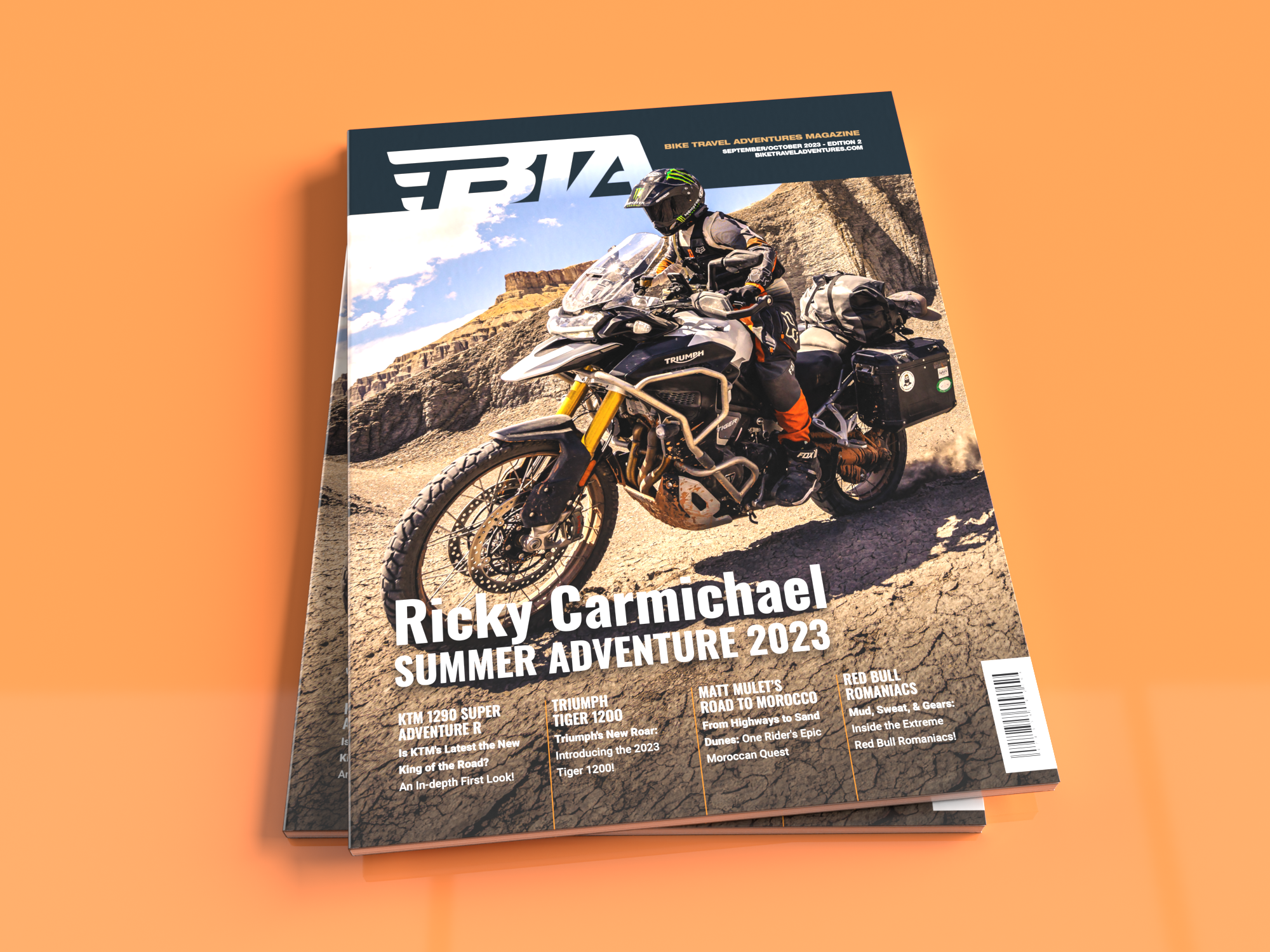
Articles in this issue
Riding with Dakar Champion
Riding with Dakar Champion Kevin BenavidesThe long-awaited journey had finally come to fruition... For years, I had dreamed of tracing the same dust-ridden paths that legends carved through the...
Riding the Icelandic Trails
Riding the Icelandic Trails Simon CudbyNote From the Editor Simon Cudby, with his compelling narrative and vivid photography, takes us on a breathtaking expedition through Iceland’s rugged scapes,...
The 2023 FIM World Rally Raid Championship
A look into the 2023 FIM world rally raid championship Thrills and ChallengesThe FIM World Rally Raid Championship, in its second year, continues to captivate the adventure motorcycle segment with...